A World War II Service Record

Ralph Harry Vuylsteke

First Lieutenant · Company B, 179th Engineer Combat Battalion
Army · Service no. 20 619 545
Service Number
20 619 545
Rank
First Lieutenant
Final Unit
Company B, 179th Engineer Combat Battalion
MOS
Platoon Commander, Company B
Theater
European Theater of Operations (ETO)
This timeline reconstructs Ralph's World War II service from the his enlistment record and the Morning Reports, orders and unit records held by the National Archives, searched by service number. Each entry cites its source; items marked Newly discovered were recovered from the records.

Map of Service

Documented service stations and the 179th Engineer Combat Battalion's route. European stops show unit movements; the connecting lines do not trace individual journeys.
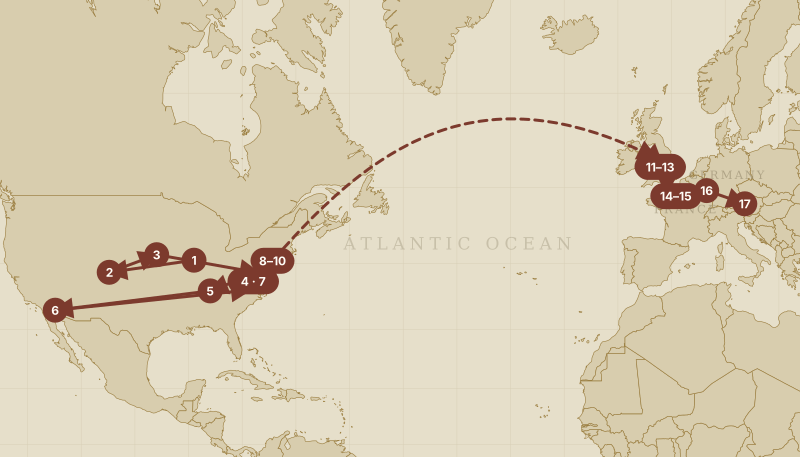
Map of documented service stations and the 179th Engineer Combat Battalion route

Service stops

  1. Bloomington, Ill.federal service, Mar 1941
  2. Camp Carson, Colo.89th QM Co, 1942-43
  3. Omaha, Neb.new lieutenant, May 1943
  4. Fort Belvoir, Va.Engineer School, Aug-Sep 1943
  5. Tennessee Maneuvers293rd Engrs, Sep 1943
  6. Desert maneuvers, Calif.293rd Engrs, Sep-Dec 1943
  7. Camp Butner, N.C.283rd Engrs, Dec 1943-Apr 1944
  8. Fort Dix, N.J.179th Engrs, Apr-Jun 1944
  9. Camp Kilmer, N.J.Company B, Jun 1944
  10. Brooklyn, N.Y.loading officer, 30 Jun 1944
  11. Liverpool, Englandbattalion landed, Jul 1944
  12. Blithfield Hall, Englandbattalion camp, Jul-Aug 1944
  13. Southampton, Englandbattalion staging, Aug 1944
  14. Omaha BeachCompany B ashore, 8 Aug 1944
  15. Seine, Ponthierrybattalion, 21 Aug 1944
  16. Saar operationsunit area, Feb 1945
  17. Vocklabruck, Austriabattalion, V-E Day

Route notes

  • 1 → 2
  • 2 → 3
  • 3 → 4
  • 4 → 5
  • 5 → 6
  • 6 → 7
  • 7 → 8
  • 8 → 9
  • 9 → 10Loading duty, 30 Jun 1944
  • 10 → 11Battalion overseas movement, Jul 1944
  • 11 → 12
  • 12 → 13
  • 13 → 14Company B landed, 8 Aug 1944
  • 14 → 15
  • 15 → 16
  • 16 → 17
First time here?

How to read this service timeline

This page brings together records created for different purposes. The labels below tell you what kind of evidence supports each entry; open either guide when a record or military term is unfamiliar.

Confirmed — Service record

A personal military record supports the entry.

Confirmed — Unit record

A record created by his unit names him or documents the unit’s activity.

Context

Helpful background, clearly separated from personal evidence.

Newly discovered

Information recovered during this research, rather than supplied at the start.

How to read a Morning Report

Morning Reports were daily administrative records prepared by individual Army and Army Air Forces units. They generally recorded changes—such as arrivals, transfers, promotions, illness, or return to duty—not a complete list of everyone present.

MORNING REPORT · SAMPLE
1Organization
Company A, 123rd Infantry
2Station or location
Camp Example, Virginia
3Date
14 September 1944
4Section
Personnel changes
5Pvt Smith, John A., 35123456
6asgd fr Hq Co per SO 187, Hq 123d Inf
In plain English Private John A. Smith, identified by Army Serial Number 35123456, was assigned to Company A from Headquarters Company under Special Orders No. 187.
  1. 1Organization: the company, hospital, squadron, or other unit filing the report.
  2. 2Station or location: where that unit reported from on that date.
  3. 3Report date: the date of the report, which may differ from the effective date of a change.
  4. 4Section: the part of the form containing personnel changes or the unit’s record of events.
  5. 5Soldier entry: usually rank, name, and Army Serial Number.
  6. 6Change and authority: what happened and the order authorizing it.
asgd
assigned
atchd
attached
trfd
transferred
fr
from
aptd
appointed
EM
enlisted men
SO
Special Orders
GO
General Orders
orgn
organization
sta
station
Common military and research terms
Army Serial Number (ASN)
The unique service number used to distinguish one soldier from others with similar names.
Discharge or separation paper
The document issued when a service member left active service. For many WWII Army enlisted soldiers, this is WD AGO Form 53-55. It summarizes service but is not a day-by-day history.
Morning Report
An Army unit’s daily administrative report. It usually lists people whose status changed, not every person in the unit.
Unit record
A document created by a military organization. It may name the soldier directly or provide context about his unit; the timeline states which applies.
OMPF or “201 file”
The service member’s Official Military Personnel File. Many Army and Air Force files were damaged or destroyed in the 1973 National Personnel Records Center fire.
Unit and final unit
A unit is the organization in which someone served. The final unit is the organization shown at separation; it may not be the only unit in the service history.
Rank or grade
The service member’s level in the military hierarchy. A timeline may show changes in rank over time.
MOS
Military Occupational Specialty—the Army’s classification for a soldier’s primary military job.
Assigned and attached
Assigned means formally placed in a unit. Attached usually means serving with a unit temporarily while belonging administratively elsewhere.
Special Orders and General Orders
Official directives used to authorize personnel actions, awards, organizational changes, and other decisions.
Campaign credit
Official recognition for service connected with a named campaign. It does not, by itself, describe a service member’s individual actions.
Station or location
The place from which a unit filed a report. It does not automatically prove that every member was physically present there.
Source citation
The note beneath a timeline entry identifying the record or records that support it.

Service Timeline

18 min
Confirmed — Record
February 16, 1922

Born in Illinois

Ralph Harry Vuylsteke is born in Illinois, the second of three children of Harry and Helen Vuylsteke. He grew up in Heyworth, a village in McLean County about ten miles south of Bloomington.
Source: Find A Grave memorial #53133665; VA Gravesite Locator; VA Beneficiary Identification Records Locator Subsystem; his headstone at Camp Butler National Cemetery; parents and childhood from Helen Vuylsteke's obituary, Clinton Daily Journal and Public, 8 April 1957, page 6, and 1930 census, Heyworth, household 154 (shown in the next event)
Confirmed — Record
November 10, 1925

His father dies; Ralph is three

Ralph's father, Harry A. Vuylsteke, dies when Ralph is three. Harry and Helen Steiling had married in 1919. Helen raises Ralph and his sisters, Alice and Rose, in Heyworth.

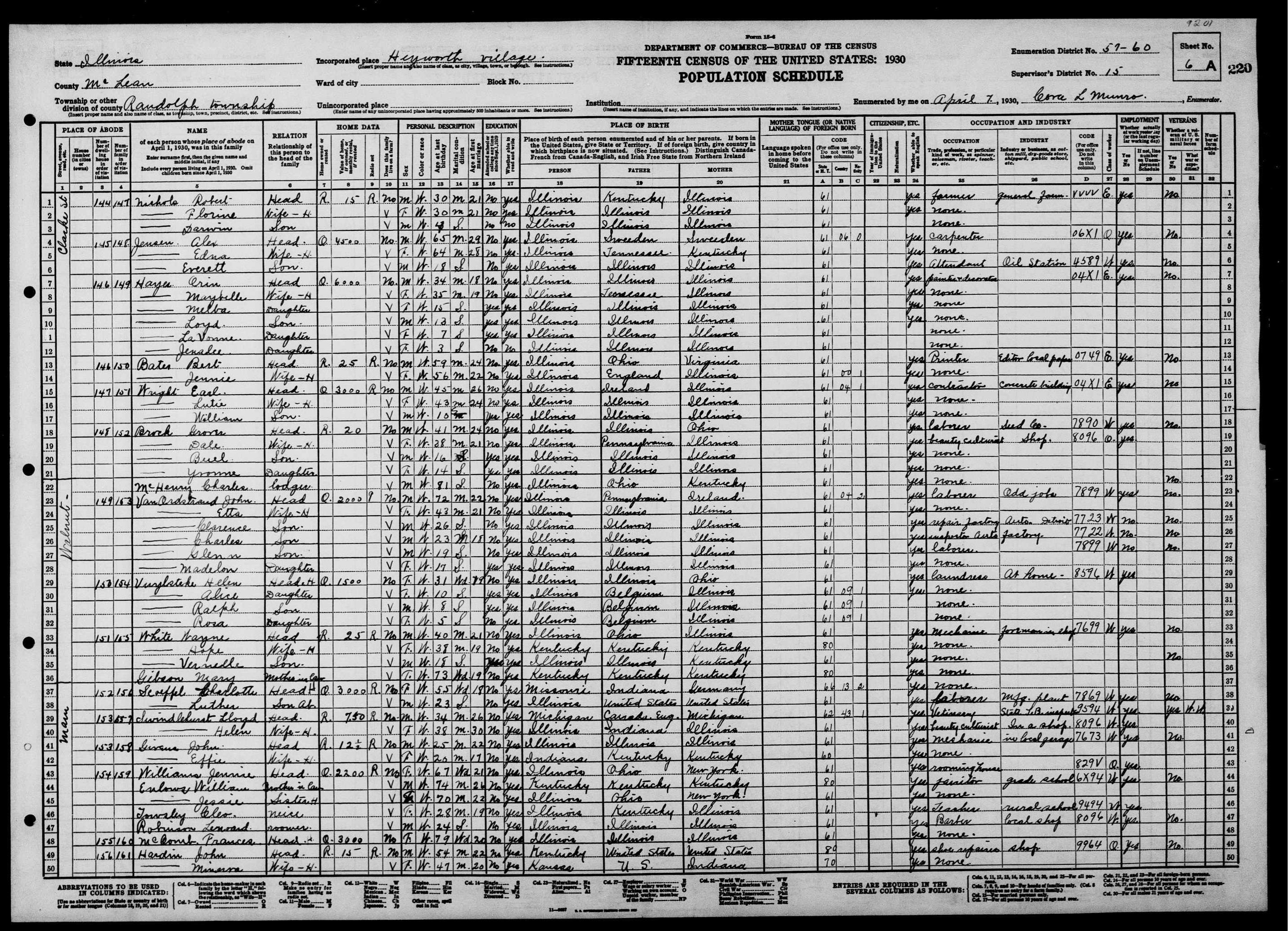
Illinois's 1929 roll of veterans' burials lists Harry as a corporal of the 65th Field Artillery, a First World War veteran buried at Heyworth. The 1930 census lists the children's father as born in Belgium.

View the burial-roll entry

1929 Illinois Roll of Honor, page 151: Vuylsteke, Harry A.; World War; Corporal; 65 Field Artillery; Heyworth Cemetery; died 10 November 1925. The linked online transcription also lists his name, war, unit and cemetery.
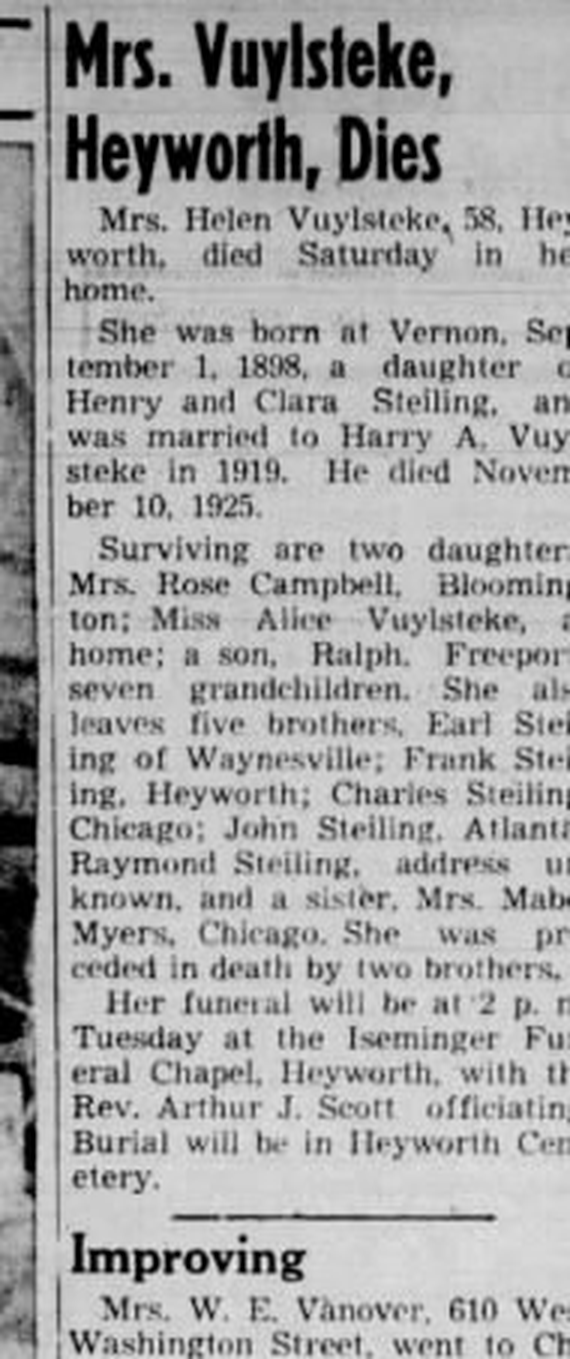
scanned record
Helen's obituary supplies Harry's name, their marriage year and his death date. The yellow is ours — it marks his name and service number on the sheet.
scanned record
1930 census of Heyworth, sheet 6A, taken 7 April 1930. Lines 29–32: Helen Vuylsteke, a widow, with Alice, Ralph (8) and Rosa. The father's birthplace column reads Belgium for all three children. The yellow is ours — it marks his name and service number on the sheet.
Source: Obituary of Helen Vuylsteke, Clinton Daily Journal and Public, 8 April 1957, page 6; Roll of Honor: Record of Burial Places of Soldiers, Sailors, Marines and Army Nurses of All Wars of the United States Buried in the State of Illinois (Illinois Military and Naval Department, 1929), page 151: https://books.google.com/books?id=KFoBAAAAMAAJ&pg=PA151; 1930 U.S. census, Heyworth village, McLean County, Illinois, enumeration district 57-60, household of Helen Vuylsteke: https://www.familysearch.org/ark:/61903/1:1:XSB5-B2H; Find A Grave memorial #63676624; online transcription of the 1929 roll: https://genealogytrails.com/ill/mclean/mil_1929_honor_roll_mclean_county.html
Confirmed — Unit record
July 2, 1940

Joins the Illinois National Guard

A few weeks after finishing Heyworth High School, Ralph volunteers for the Illinois National Guard, the state's part-time army. He is eighteen.

The date appears on an Army roster typed two years later, which lists each man's branch, his component and the day he enlisted beside his name. Ralph's line reads NG 2-7-40: National Guard, 2 July 1940. That roster wrote dates day first, so 2-7-40 is the second of July. His 1943 wedding notice says the same thing in plain words: he was graduated from Heyworth High School with the class of 1940 and “shortly thereafter volunteered for army service.”
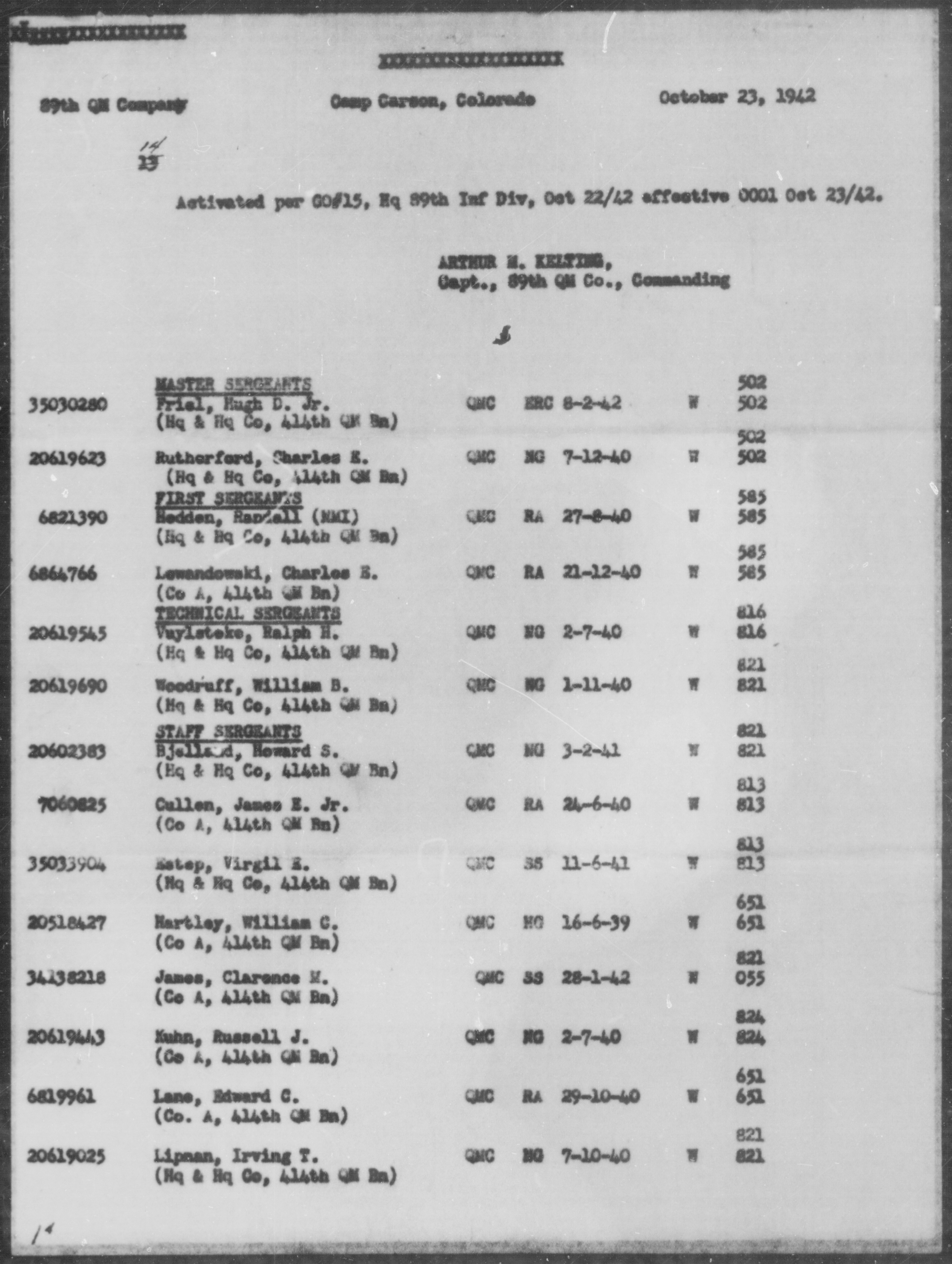
scanned record
The 1942 roster. On his line, “NG 2-7-40” is his National Guard enlistment date, 2 July 1940. The yellow is ours — it marks his name and service number on the sheet.
Source: Morning Report — 89th Quartermaster Company — NARA Roll 2452, part 4 of 5, NAID 439483467, image 3658 (October 23, 1942); The Pantagraph (Bloomington), 29 December 1943, page 6
Confirmed — Record
December 18, 1940

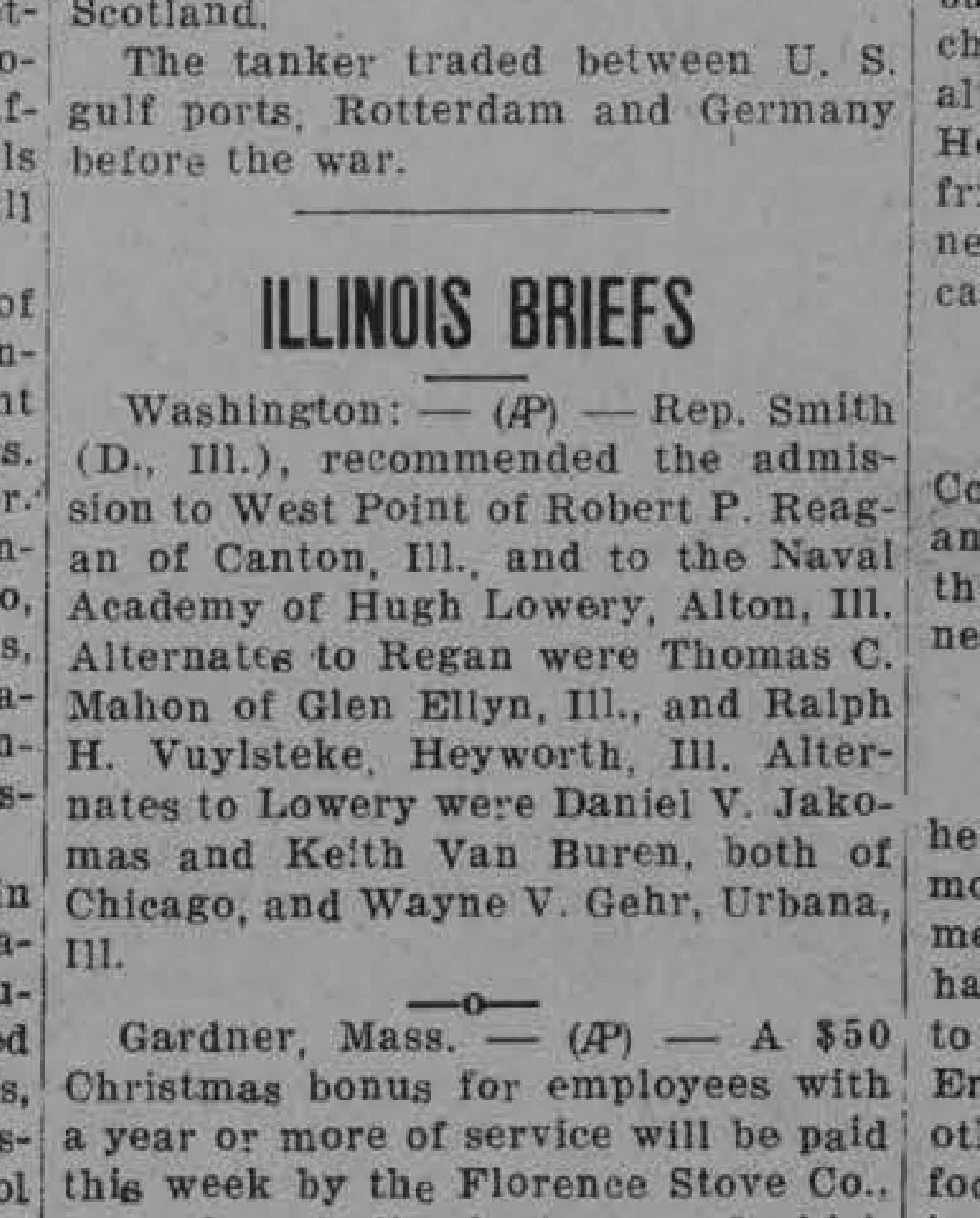
Recommended as an alternate for West Point

A newspaper report names eighteen-year-old Ralph H. Vuylsteke of Heyworth as an alternate recommended for admission to West Point, the United States Military Academy. An alternate nomination offered a possible place, subject to selection and admission requirements.

Eleven weeks later Ralph entered federal Army service as a Private. His company reports document his later move to Officer Candidate School and his service as a Second Lieutenant.
scanned record
The item as it was printed, from page one of the 18 December 1940 issue. The yellow is ours — it marks his name and service number on the sheet.
Source: Galena Daily Gazette, Wednesday 18 December 1940, page 1, ILLINOIS BRIEFS column; 89th Quartermaster Company report, roll 2452 part 4, image 3742; Company B, 179th Engineer Combat Battalion report, roll 295 part 1, image 238
Confirmed — Service record
March 5, 1941

Called into federal service at Bloomington, Illinois

Ralph enters federal service at Bloomington, Illinois, as a Private in the Quartermaster Corps, the branch that kept the Army supplied with food, fuel, clothing and transport. He is nineteen.

His Army service number is 20 619 545. The enlistment record identifies him as a National Guardsman.

View the enlistment-record transcription

National Archives Army Serial Number Electronic File, Merged Processed File, serial 20619545: VUYLSTEKE RALPH H; residence Illinois, McLean County; enlistment station Bloomington, Illinois; date 5 March 1941; grade Private; branch Quartermaster Corps; component National Guard; born Illinois, 1922. These are the decoded database fields, not a discharge certificate.

Source: National Archives (AAD), Army Serial Number Electronic File, Merged Processed File (Record Group 64), serial 20619545, box/reel 03533.74; decoded record fields transcribed above; VA BIRLS, retained database row 8991113
Confirmed — Unit record
October 23, 1942

Camp Carson, Colorado: a Technical Sergeant at twenty

The Army activates the 89th Quartermaster Company, the supply company of the newly formed 89th Infantry Division, at Camp Carson, Colorado, and a clerk types its first roster. Under TECHNICAL SERGEANTS: 20619545  Vuylsteke, Ralph H.  QMC  NG, coming across from Headquarters & Headquarters Company, 414th Quartermaster Battalion.

In nineteen months he has risen from Private to Technical Sergeant, the second-highest enlisted grade. This roster puts his name and his service number on the same line.
scanned record
The activation roster of the 89th Quartermaster Company, 23 October 1942. His line is the first under TECHNICAL SERGEANTS. The yellow is ours — it marks his name and service number on the sheet.
Source: Morning Report — 89th Quartermaster Company, 89th Infantry Division, Camp Carson, Colorado — NARA Roll 2452, part 4 of 5, NAID 439483467, image 3658 (October 23, 1942)
Confirmed — Unit record
December 11, 1942

Camp Carson, winter 1942–43: a furlough, and a week in the hospital

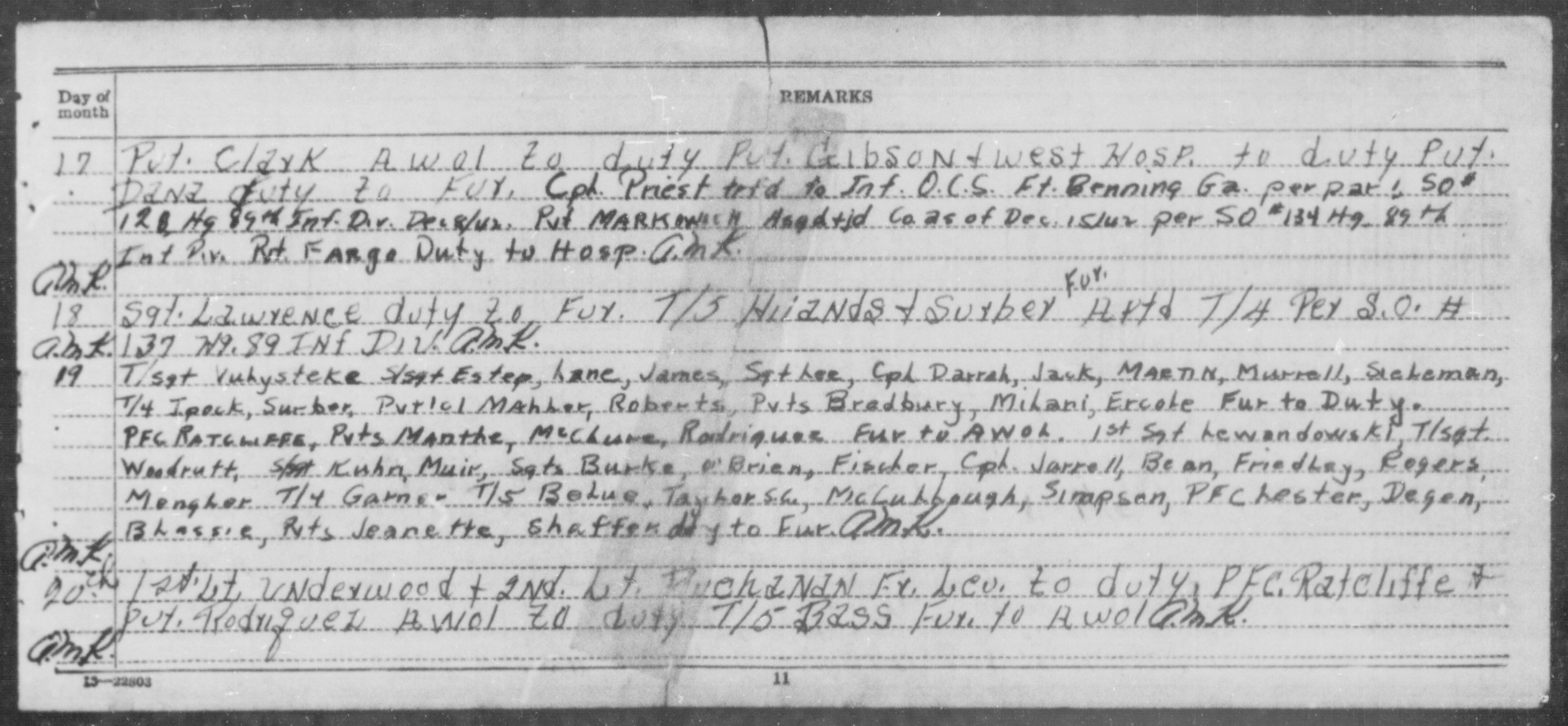
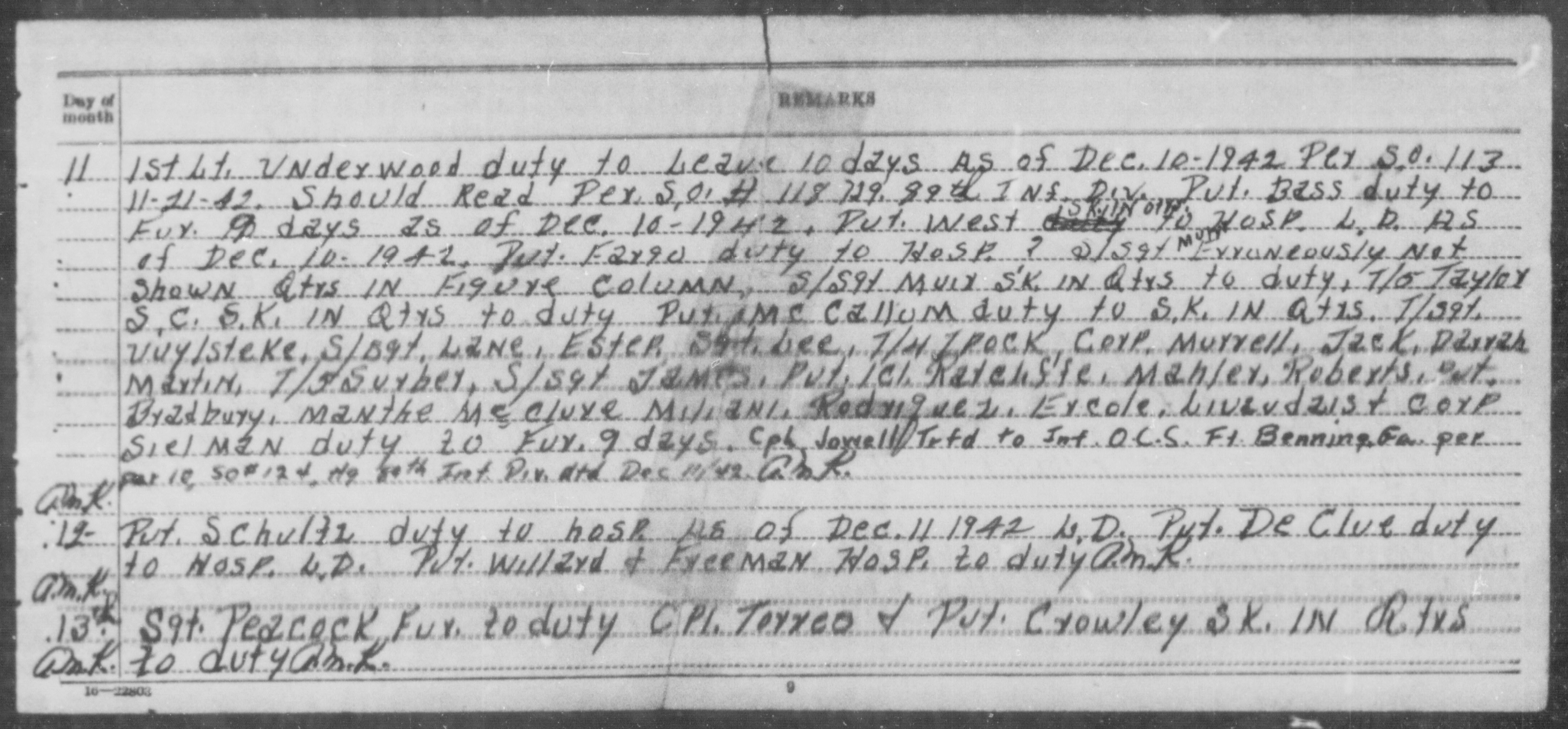
The company's handwritten Morning Reports follow him through the winter. On 11 December 1942 T/Sgt Vuylsteke and about twenty other men go “duty to Fur. 9 days”, a nine-day furlough, and on 19 December the report lists them “Fur to Duty.”

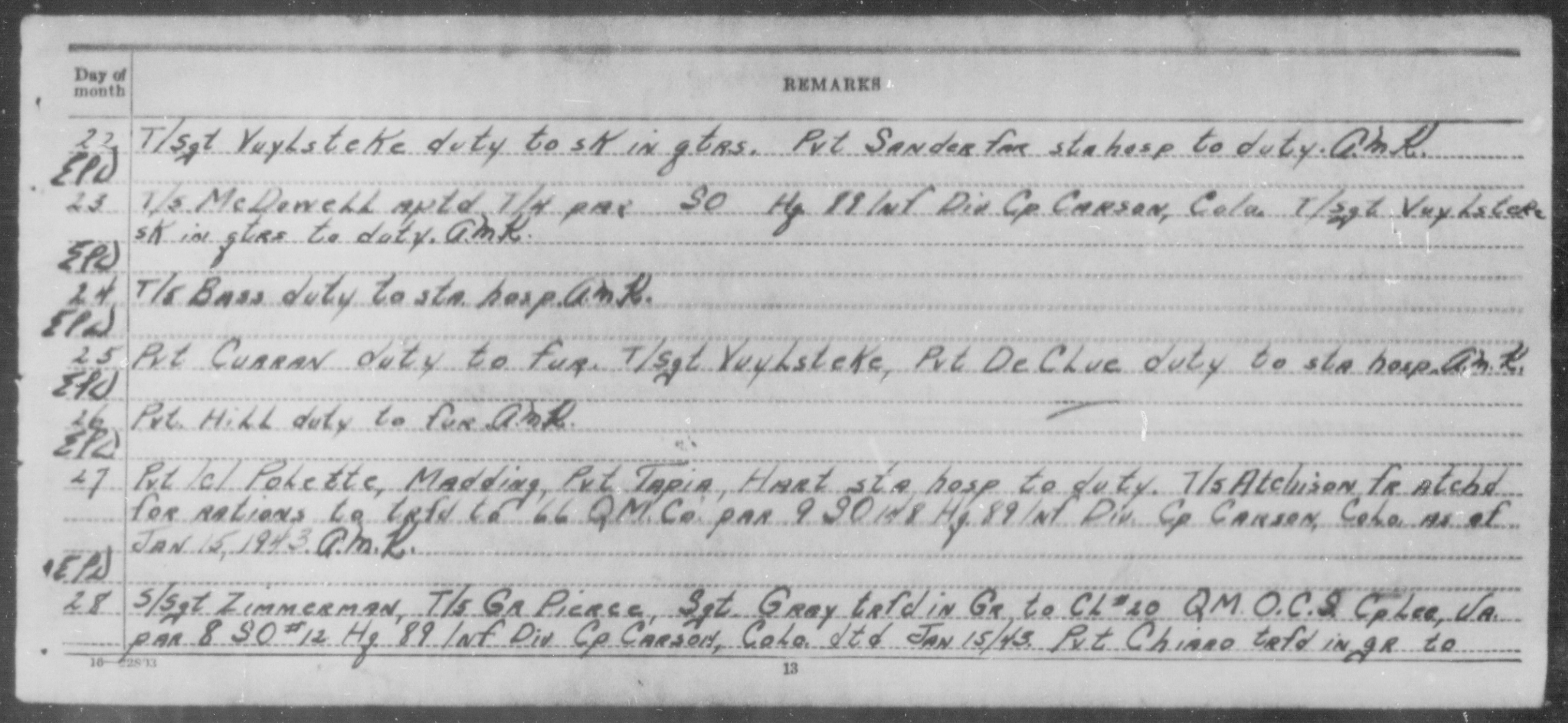
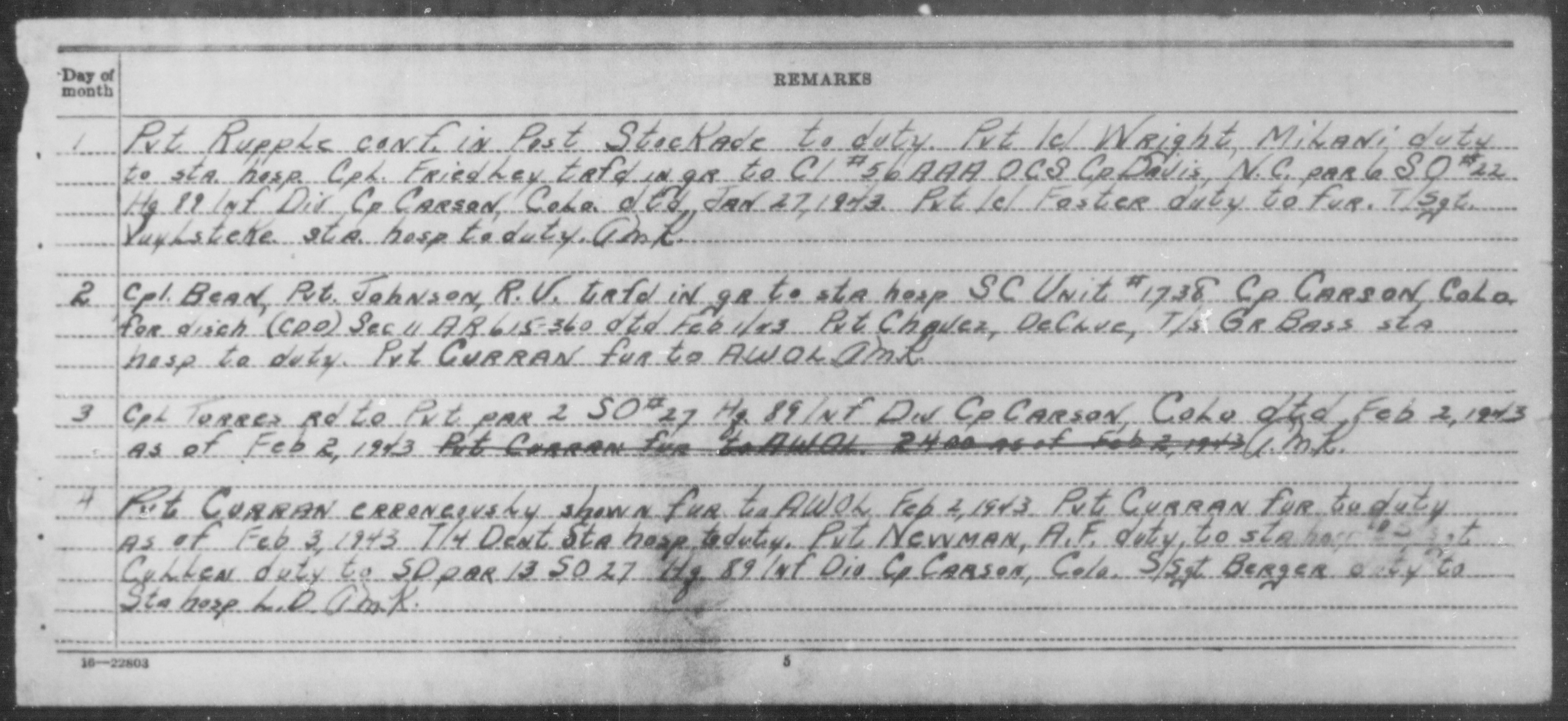
On 22 January 1943 he is “duty to sk in qtrs”, sick in quarters, and on 25 January “duty to sta hosp”, into the station hospital at Camp Carson. On 1 February the report reads “T/Sgt Vuylsteke sta hosp to duty.” Two and a half weeks later he left for Officer Candidate School.
scanned record
11 December 1942: “T/Sgt Vuylsteke” heads the list going on furlough. The yellow is ours — it marks his name and service number on the sheet.
scanned record
19 December 1942: back from furlough to duty. The yellow is ours — it marks his name and service number on the sheet.
scanned record
22 and 25 January 1943: sick in quarters, then to the station hospital. The yellow is ours — it marks his name and service number on the sheet.
scanned record
1 February 1943: “T/Sgt Vuylsteke sta hosp to duty.” The yellow is ours — it marks his name and service number on the sheet.
Source: Morning Report — 89th Quartermaster Company, Camp Carson, Colorado — NARA Roll 2452, part 4 of 5, NAID 439483467, image 3699 (December 11, 1942); image 3701 (December 19, 1942); image 3728 (January 22–25, 1943); image 3738 (February 1, 1943)
Confirmed — Unit record
February 18, 1943

Master Sergeant, and orders to Officer Candidate School

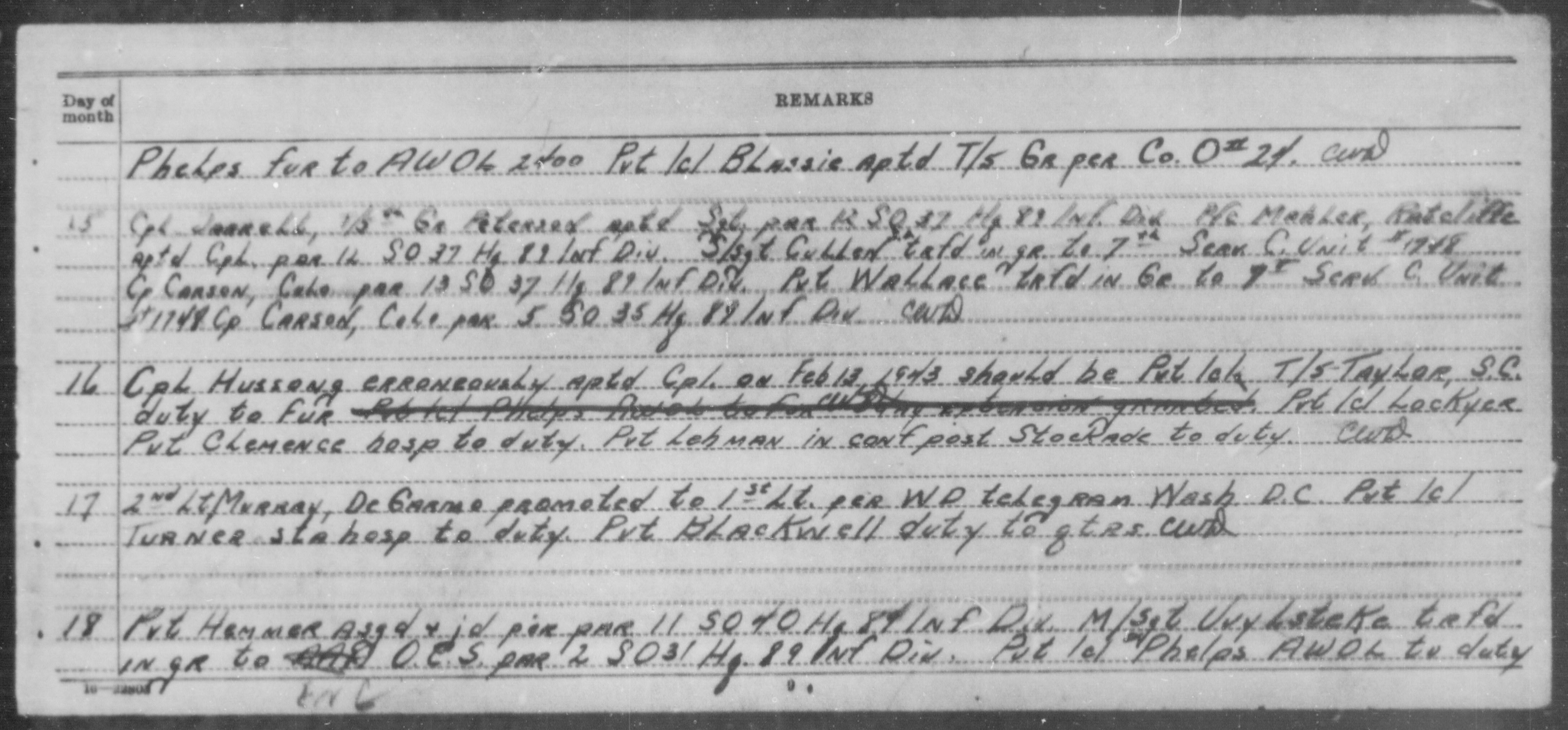
A Morning Report was the daily record each Army company kept of who joined, who left and what changed. His company's report for this day carries one line about him: “M/Sgt Vuylsteke trfd in gr to O.C.S.” Master Sergeant Vuylsteke, transferred in grade to Officer Candidate School.

Master Sergeant was the highest enlisted grade. Officer Candidate School was the Army's course of about three months that turned proven enlisted men into second lieutenants.
scanned record
The last line of the page, against day 18: “M/Sgt Vuylsteke trfd in gr to O.C.S. per 2 SO 31 Hq 89 Inf Div.” The yellow is ours — it marks his name and service number on the sheet.
Source: Morning Report — 89th Quartermaster Company, 89th Infantry Division, Camp Carson, Colorado — NARA Roll 2452, part 4 of 5, NAID 439483467, image 3742 (February 18, 1943)
Confirmed — Unit record
May 12, 1943

Second Lieutenant: his recorded date of rank
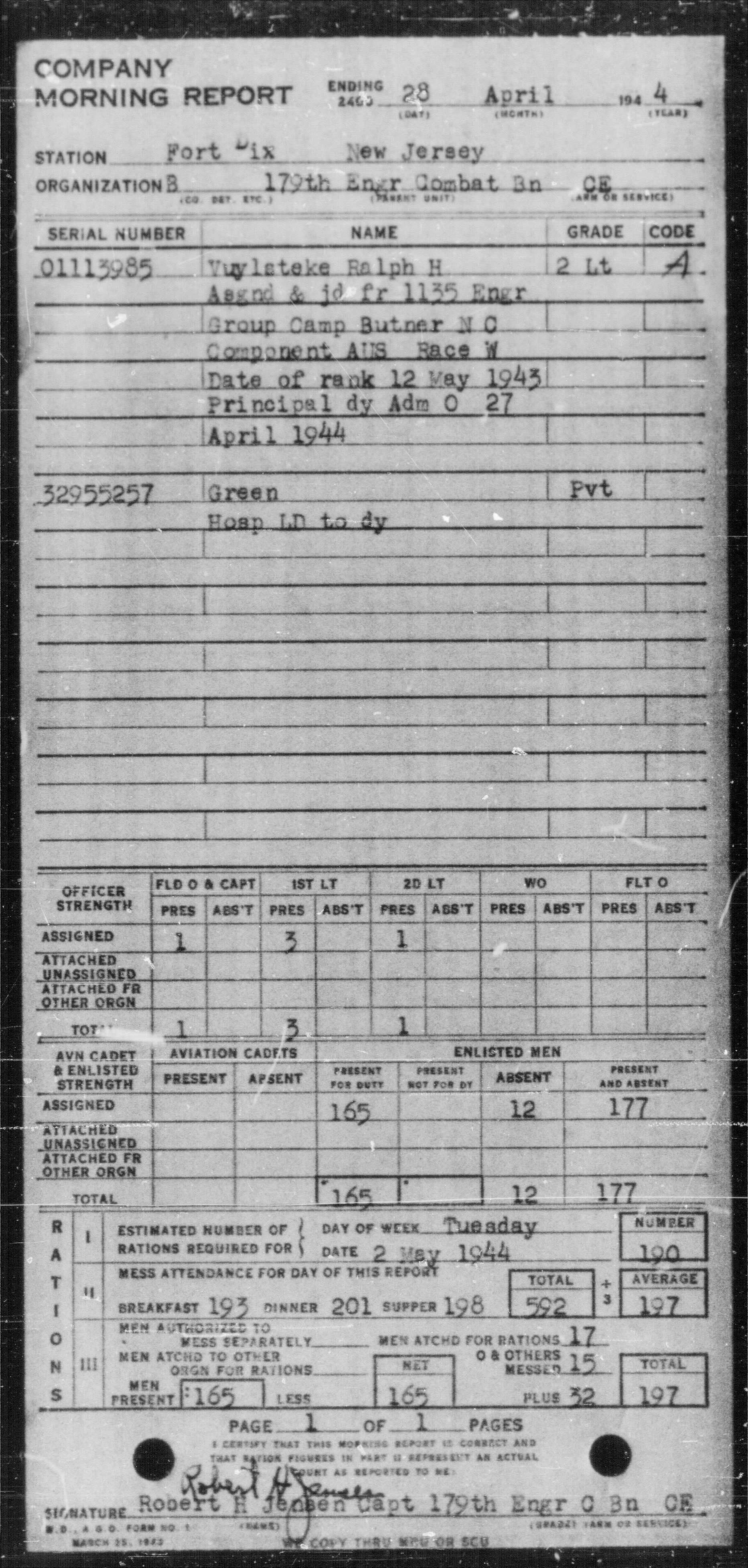
An Army report gives 12 May 1943 as Ralph's date of rank as a Second Lieutenant, the first commissioned officer rank. Date of rank establishes seniority in that grade. The clerk entered it on his April 1944 joining report, along with his officer service number, O-1113985.
scanned record
“Date of rank 12 May 1943”, on his joining report of April 1944. The yellow is ours — it marks his name and service number on the sheet.
Source: Morning Report — Company B, 179th Engineer Combat Battalion, Fort Dix, New Jersey — NARA Roll 295, part 1 of 4, NAID 468273423, image 238 (April 28, 1944)
Confirmed — Unit record
May 27, 1943

On the road as a new lieutenant

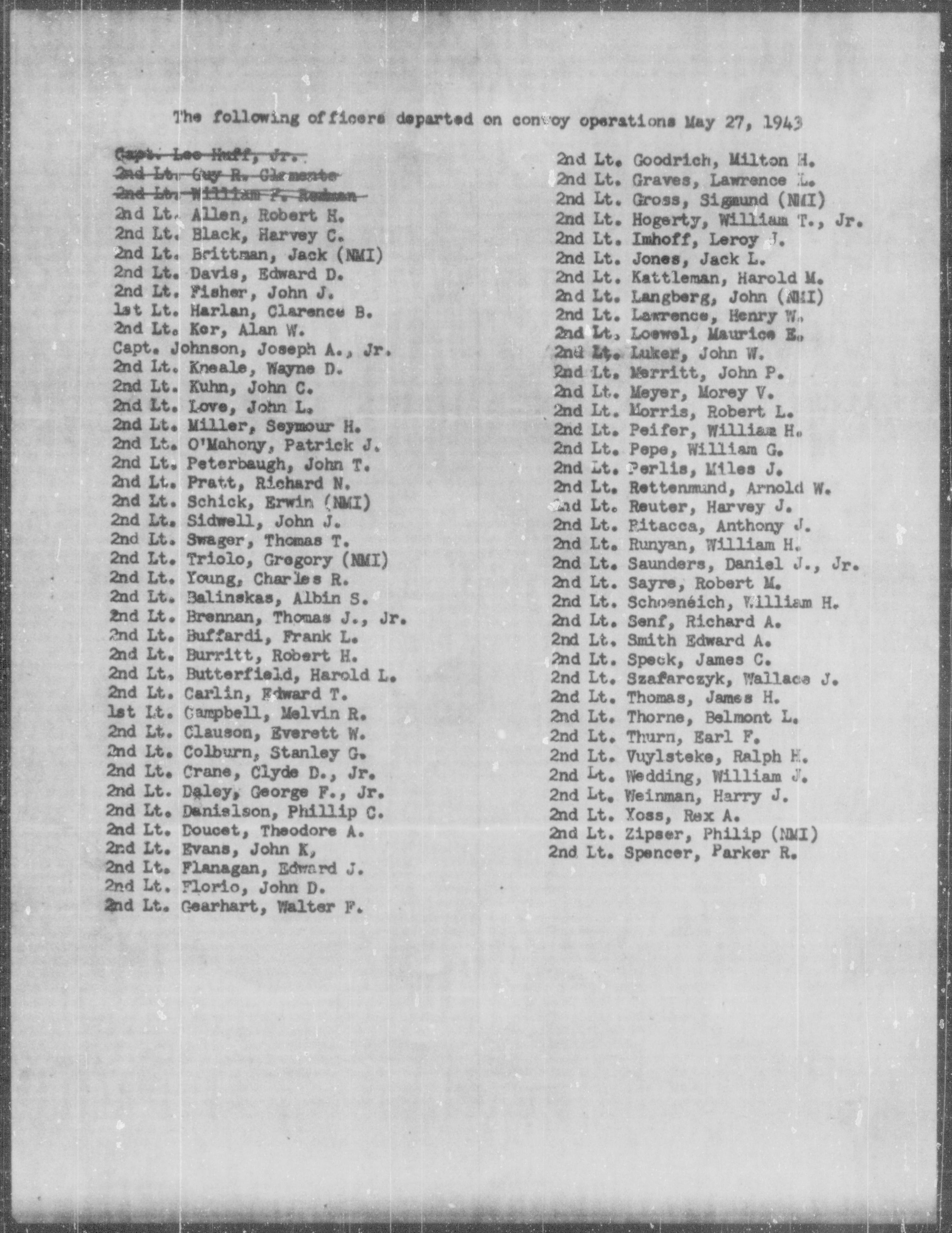
Two weeks after his commission, the Officers Annex of the Ordnance Automotive School at Omaha, Nebraska, reports: “The following officers departed on convoy operations May 27, 1943.” On the list of more than eighty officers, nearly all of them second lieutenants, is 2nd Lt. Vuylsteke, Ralph H.

A convoy operation moved a column of Army vehicles by road.
scanned record
His name near the foot of the second column. The yellow is ours — it marks his name and service number on the sheet.
Source: Morning Report — Ordnance Automotive School Officers Annex, Omaha — NARA Roll 2822, part 1 of 5, NAID 441049328, image 878 (May 27, 1943)
Confirmed — Unit record
August 26, 1943

An engineer officer: Fort Belvoir and the Tennessee Maneuvers

By the summer of 1943 Ralph has moved from the Quartermaster Corps to the Corps of Engineers, as an officer of Company C, 293rd Engineer Combat Battalion. The battalion was then on the Tennessee Maneuvers, the large war-games the Army staged in the hills east of Nashville. Combat engineers built and blew up bridges, cleared and laid mines, kept roads open and ferried troops across rivers, often under fire.

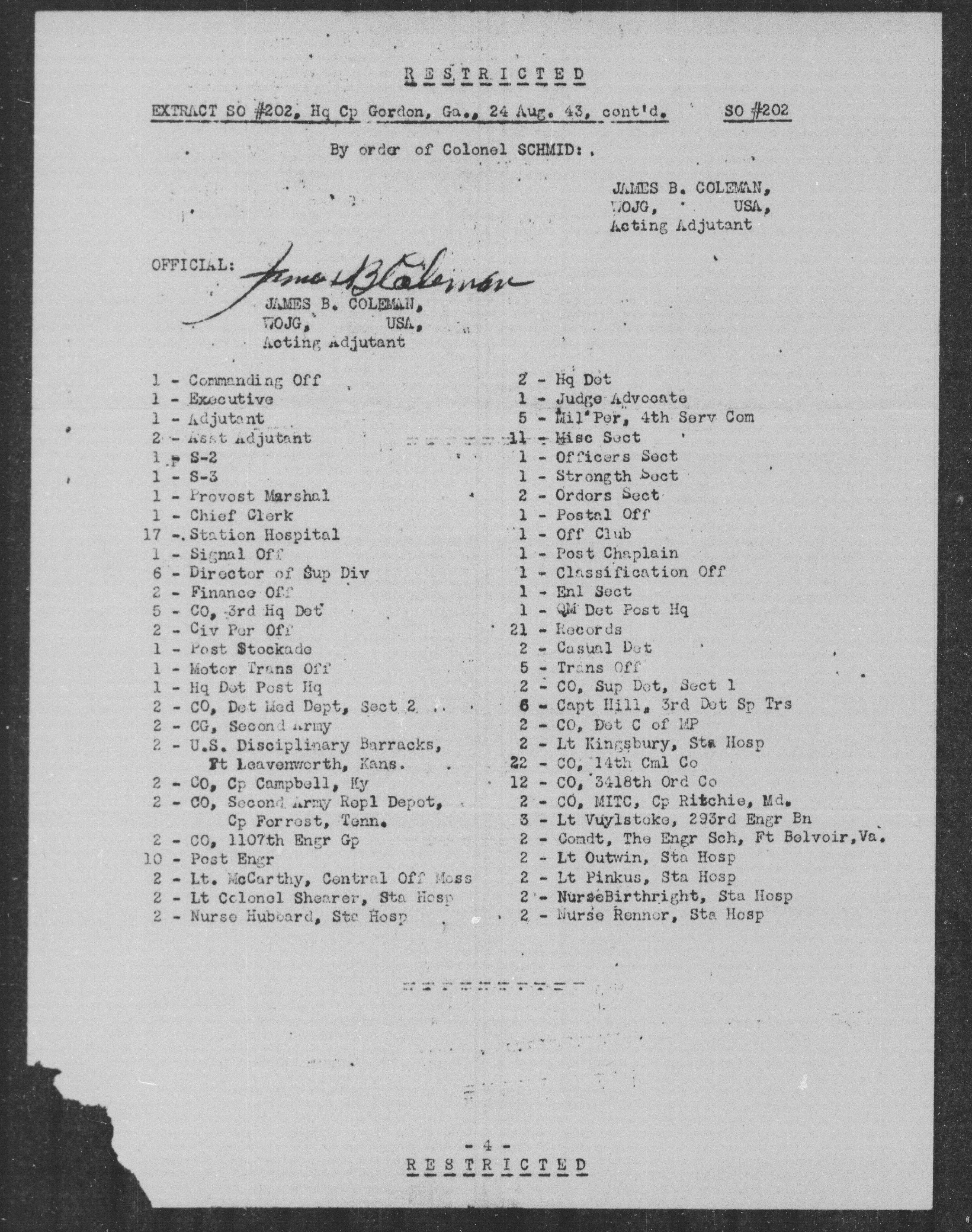
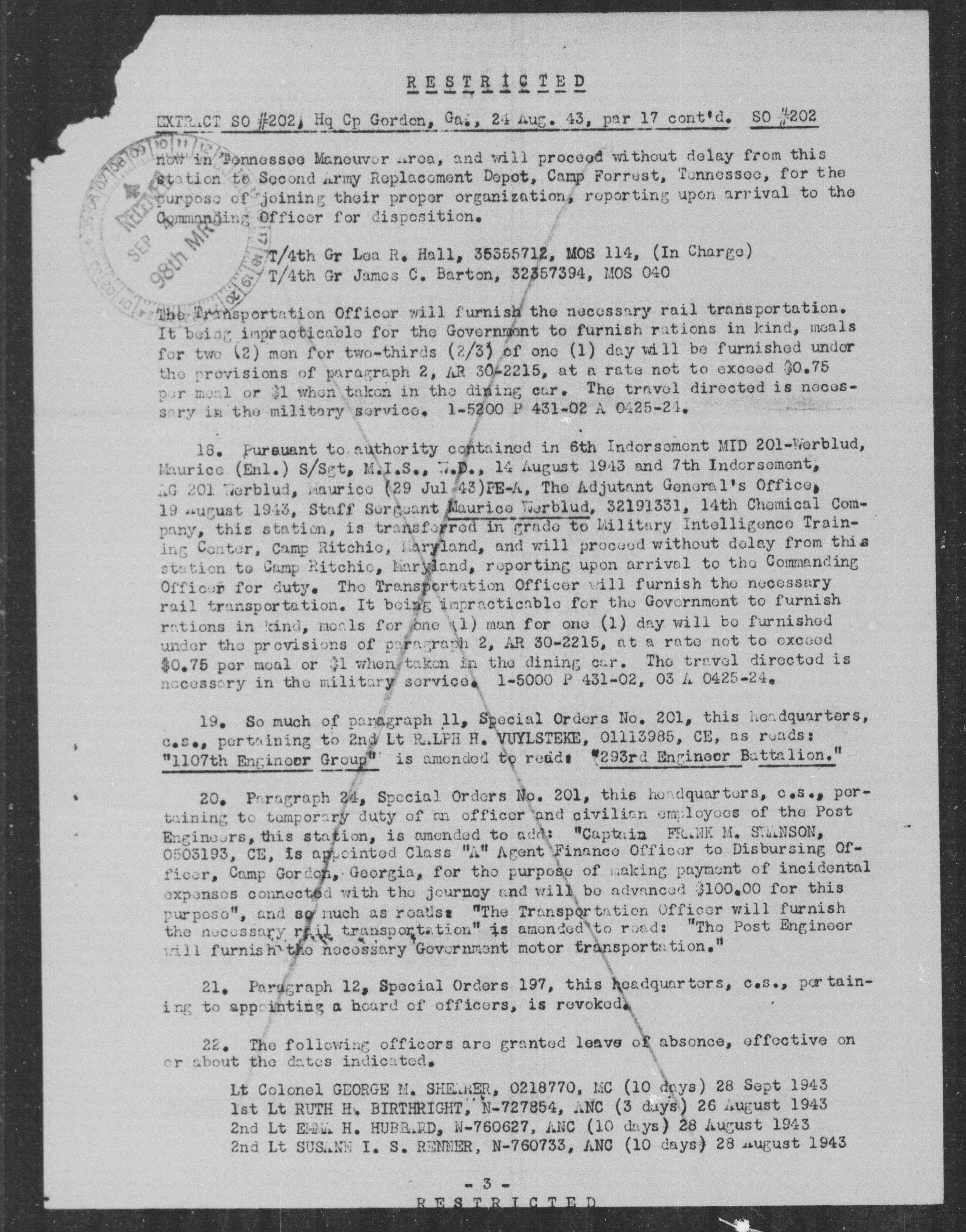
His orders came from Camp Gordon, Georgia. Special Orders No. 202 of 24 August corrected them: “So much of paragraph 11, Special Orders No. 201 … pertaining to 2nd Lt RALPH H. VUYLSTEKE, 01113985, CE, as reads: ‘1107th Engineer Group’ is amended to read: ‘293rd Engineer Battalion.’” “CE” after his serial is the Corps of Engineers.

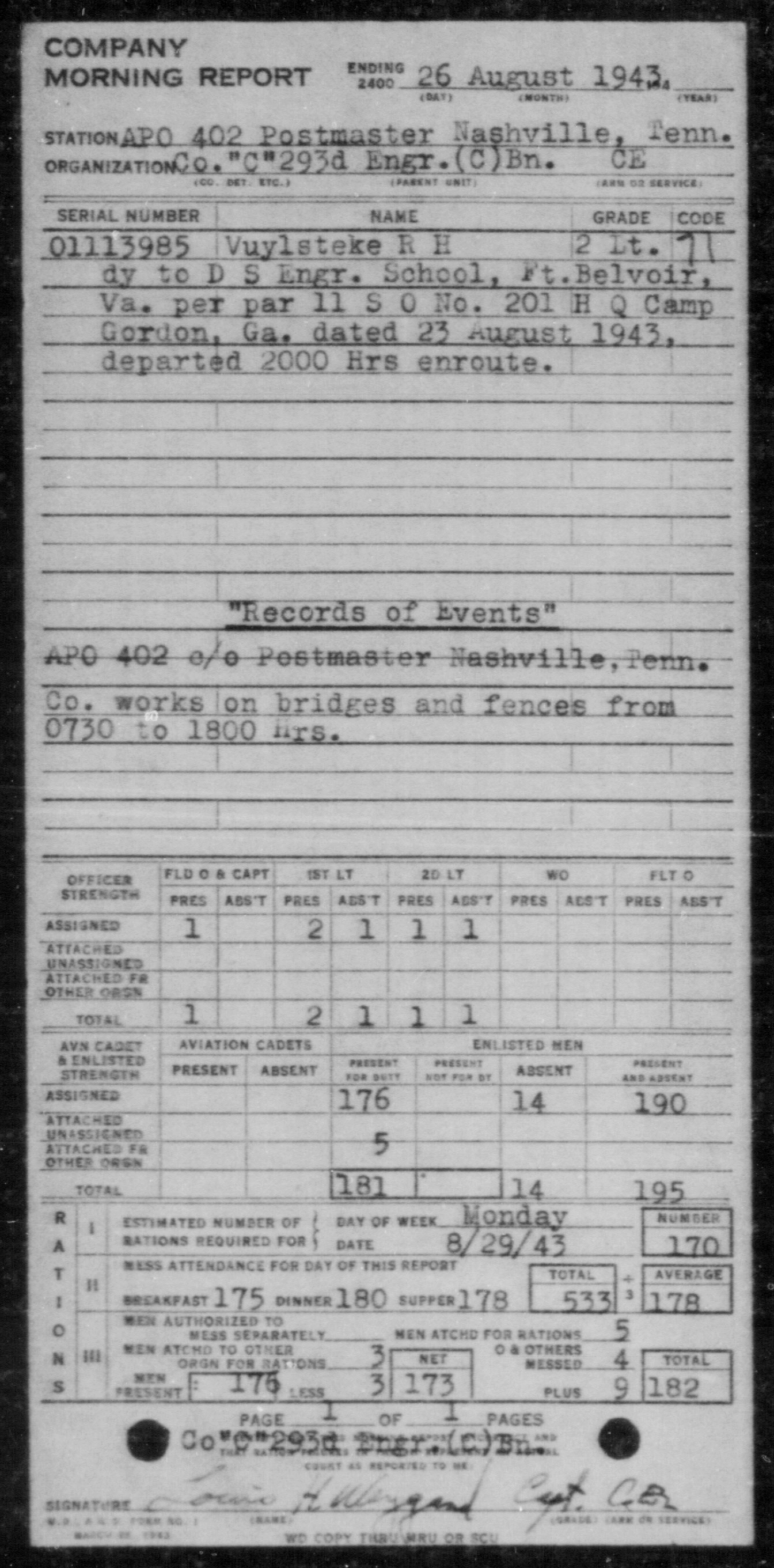
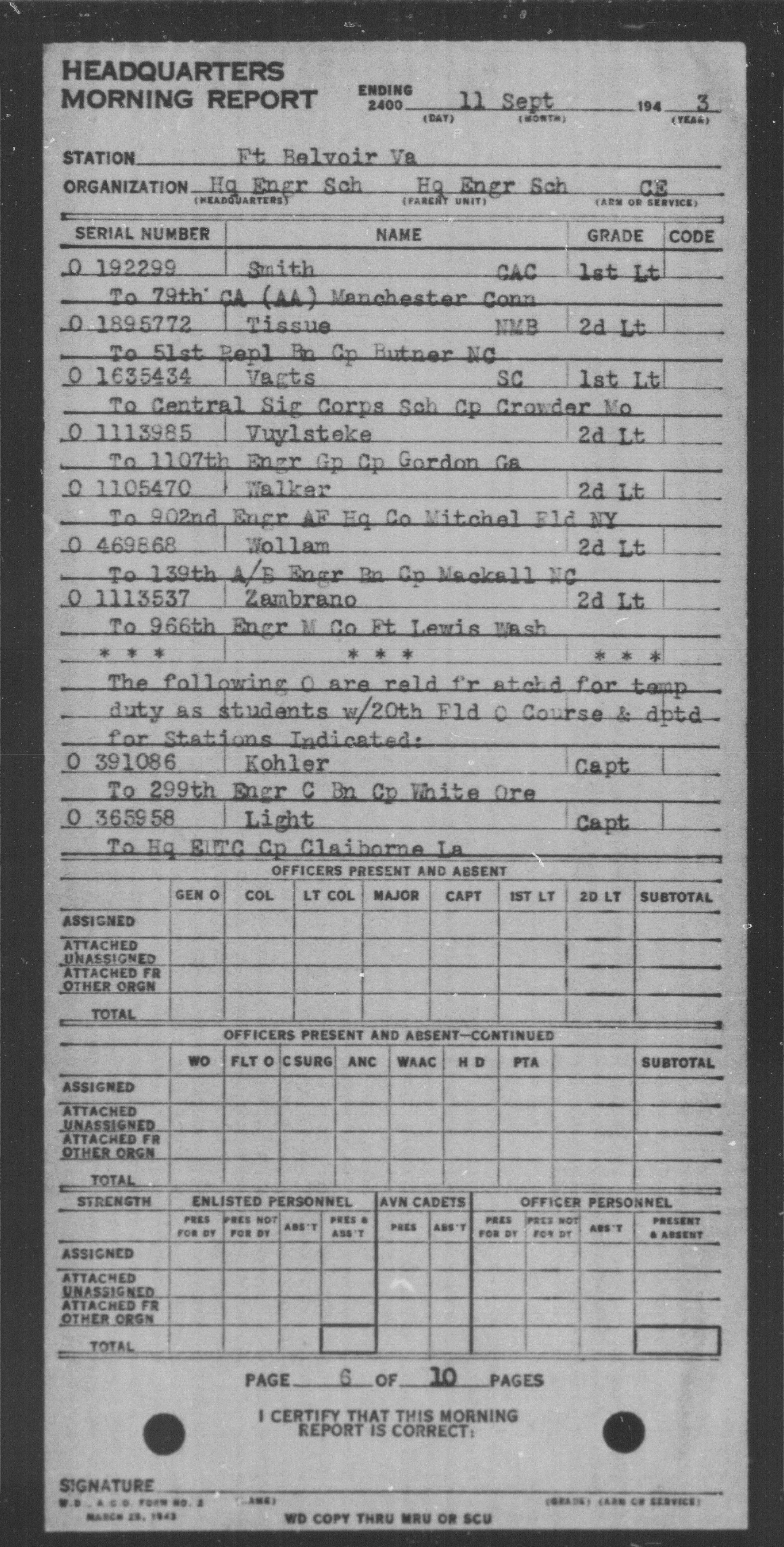
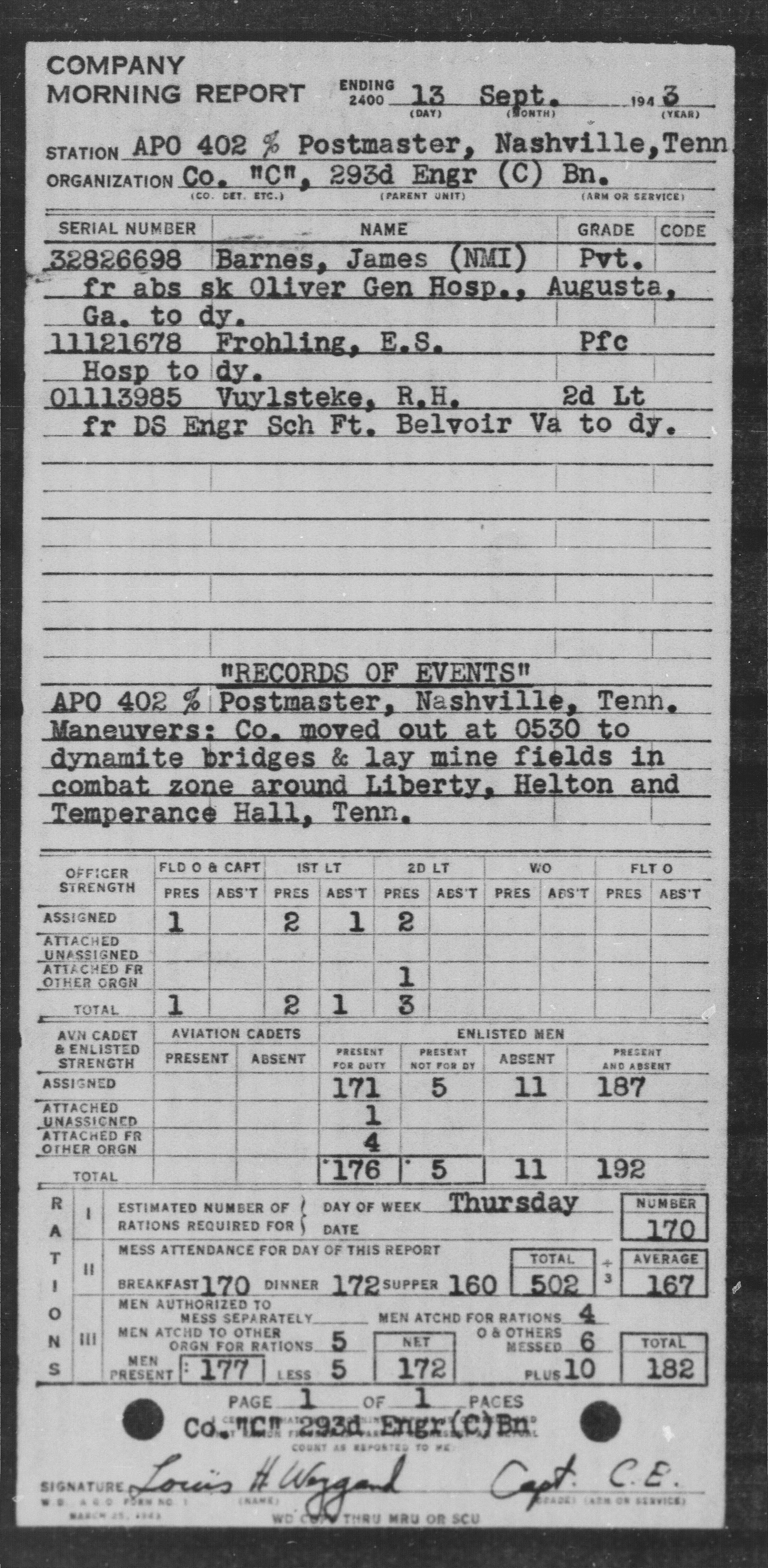
On 26 August Company C reports him “dy to D S Engr. School, Ft. Belvoir, Va. … departed 2000 Hrs enroute”: sent on detached service to the Engineer School at Fort Belvoir, Virginia, where the Army trained its engineer officers. The school's own report for 11 September lists his departure for Camp Gordon. On 13 September he is back with the company: “fr DS Engr Sch Ft. Belvoir Va to dy”. That morning the company “moved out at 0530 to dynamite bridges & lay mine fields in combat zone around Liberty, Helton and Temperance Hall, Tenn.” These were training exercises in Tennessee.
scanned record
Special Orders No. 202, Camp Gordon, 24 August 1943. Paragraph 19 changes his assignment to read “293rd Engineer Battalion.” The yellow is ours — it marks his name and service number on the sheet.
scanned record
The same order's distribution list: three copies to “Lt Vuylstoke, 293rd Engr Bn”, the clerk's spelling, and two to the Engineer School at Fort Belvoir. The yellow is ours — it marks his name and service number on the sheet.
scanned record
26 August 1943: off to the Engineer School at Fort Belvoir. The yellow is ours — it marks his name and service number on the sheet.
scanned record
11 September 1943: the Engineer School's report. “0 1113985 Vuylsteke 2d Lt” is the fourth entry, leaving the school for Camp Gordon, Georgia. The yellow is ours — it marks his name and service number on the sheet.
scanned record
13 September 1943: back to duty, and the company's day on maneuvers. The yellow is ours — it marks his name and service number on the sheet.
Source: Special Orders No. 202, Headquarters Camp Gordon, Georgia, 24 August 1943, paragraph 19, filed with the Morning Reports, roll 197, part 2 of 4, NAID 449893177, images 1604–1605; Morning Report — Company C, 293rd Engineer Combat Battalion, Tennessee Maneuver Area — NARA Roll 260, part 1 of 3, NAID 444159711, image 875 (August 26, 1943); Morning Report — Headquarters, Engineer School, Fort Belvoir, Virginia — NARA Roll 361, part 3 of 4, NAID 451001153, image 2753 (September 11, 1943); Morning Report — Company C, 293rd Engineer Combat Battalion — NARA Roll 127, part 1 of 4, NAID 449673635, image 785 (September 13, 1943)
Confirmed — Unit record
September 22 – October 31, 1943

West to the California desert

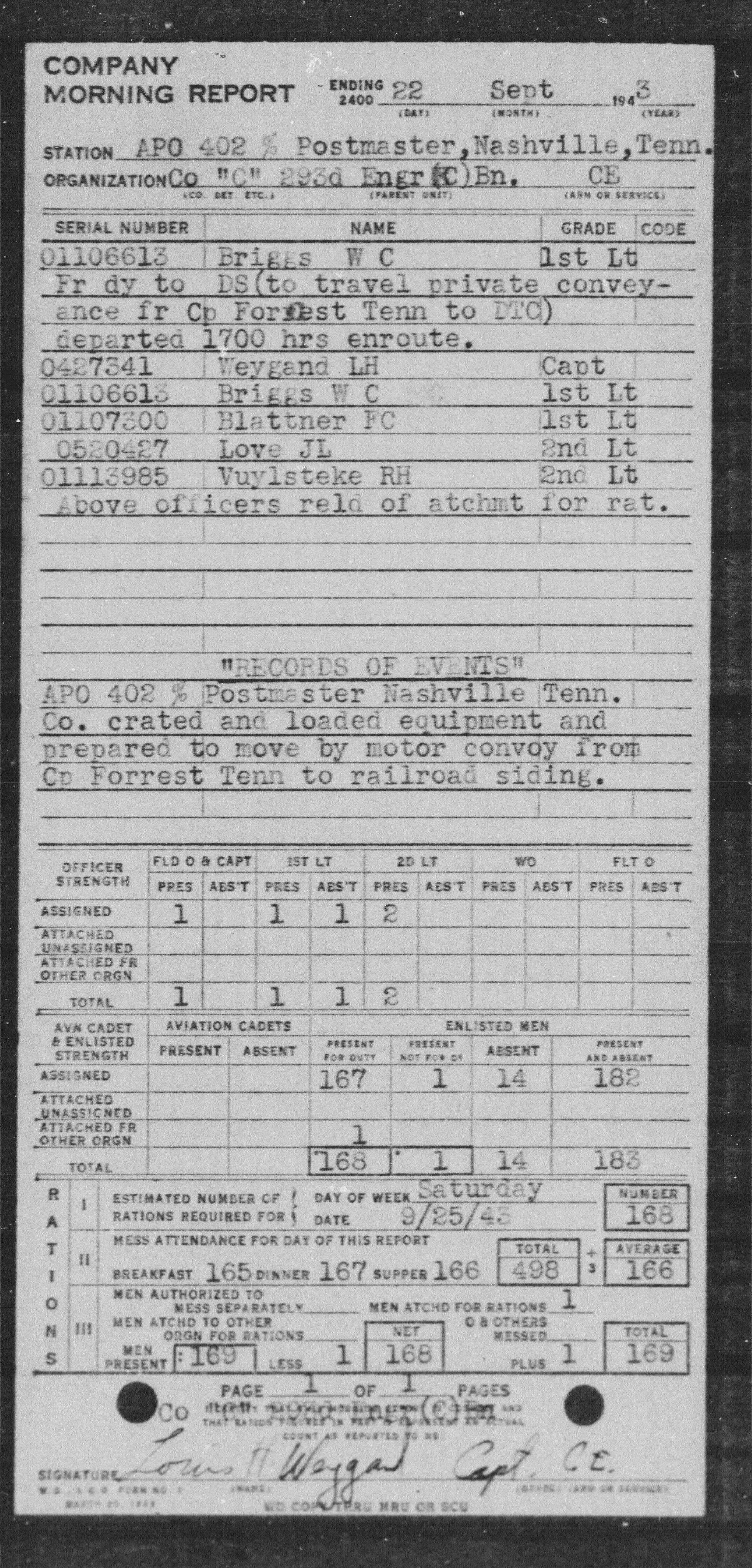
When the Tennessee Maneuvers ended, the 293rd went west. On 22 September Company C's report lists Ralph among its officers, and its record of events reads: “Co. crated and loaded equipment and prepared to move by motor convoy from Cp Forrest Tenn to railroad siding.”

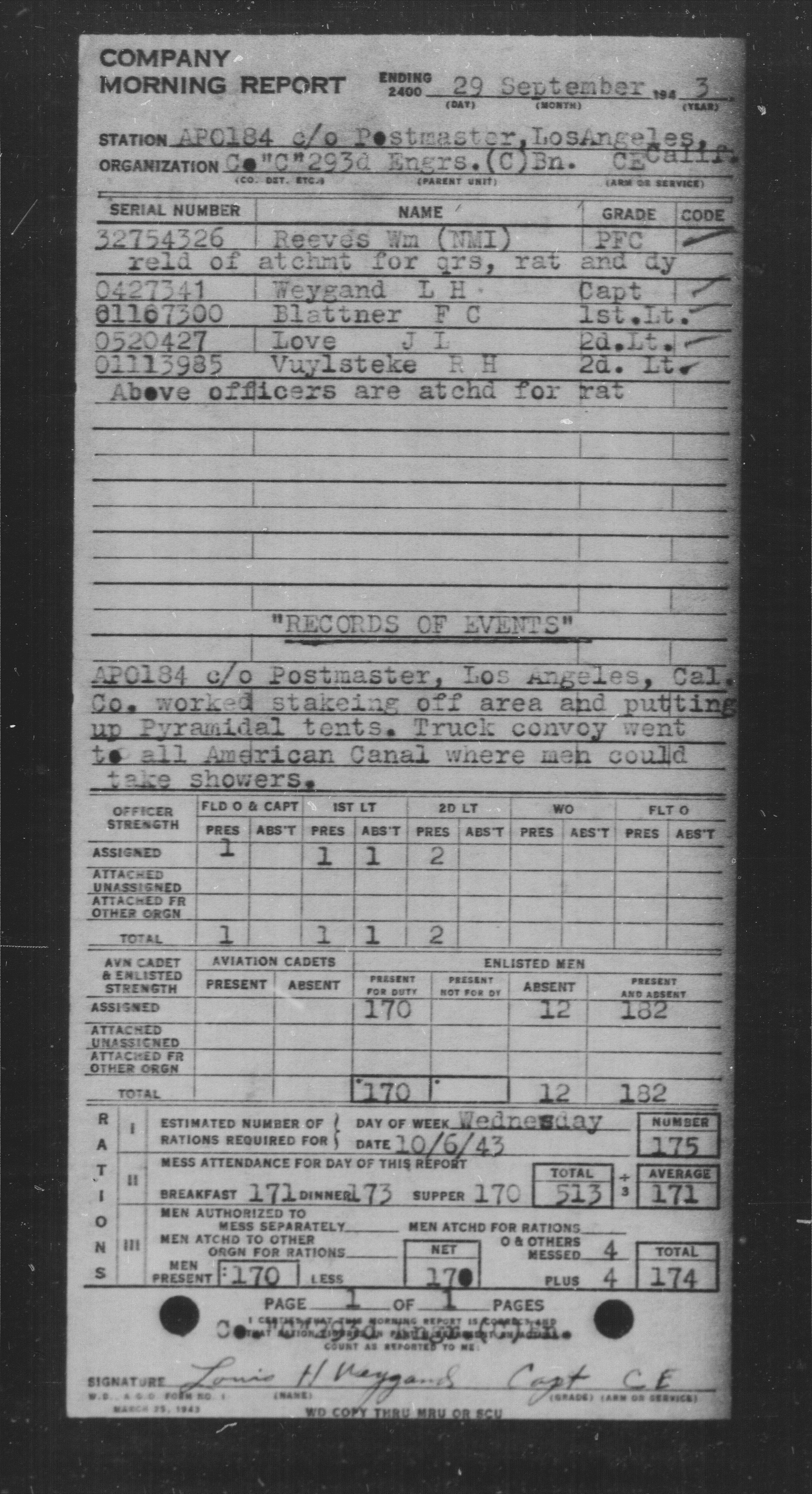
By 29 September the company was in the California desert, its mail addressed through the Los Angeles postmaster: “Co. worked staking off area and putting up Pyramidal tents. Truck convoy went to All American Canal where men could take showers.”

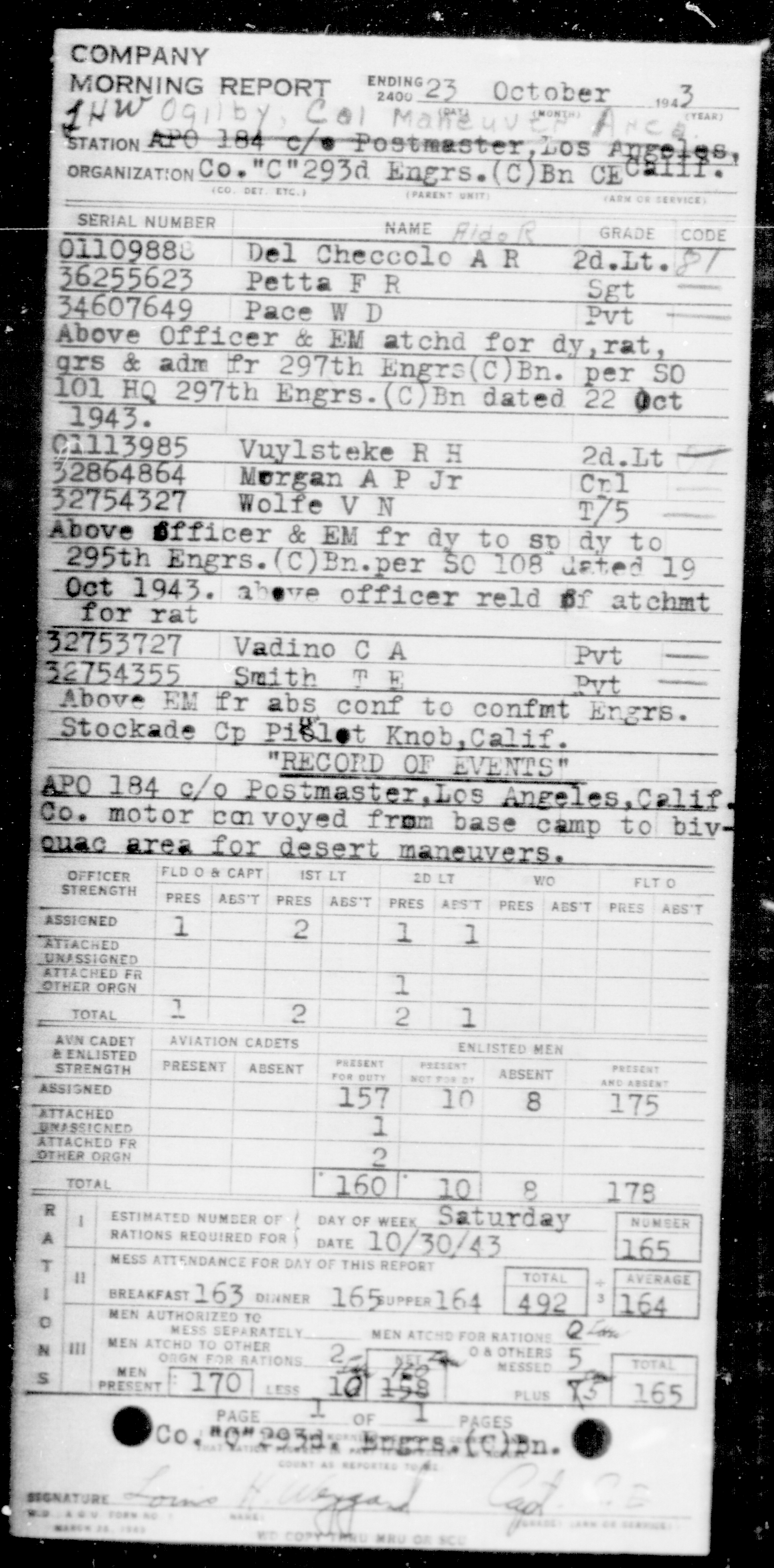
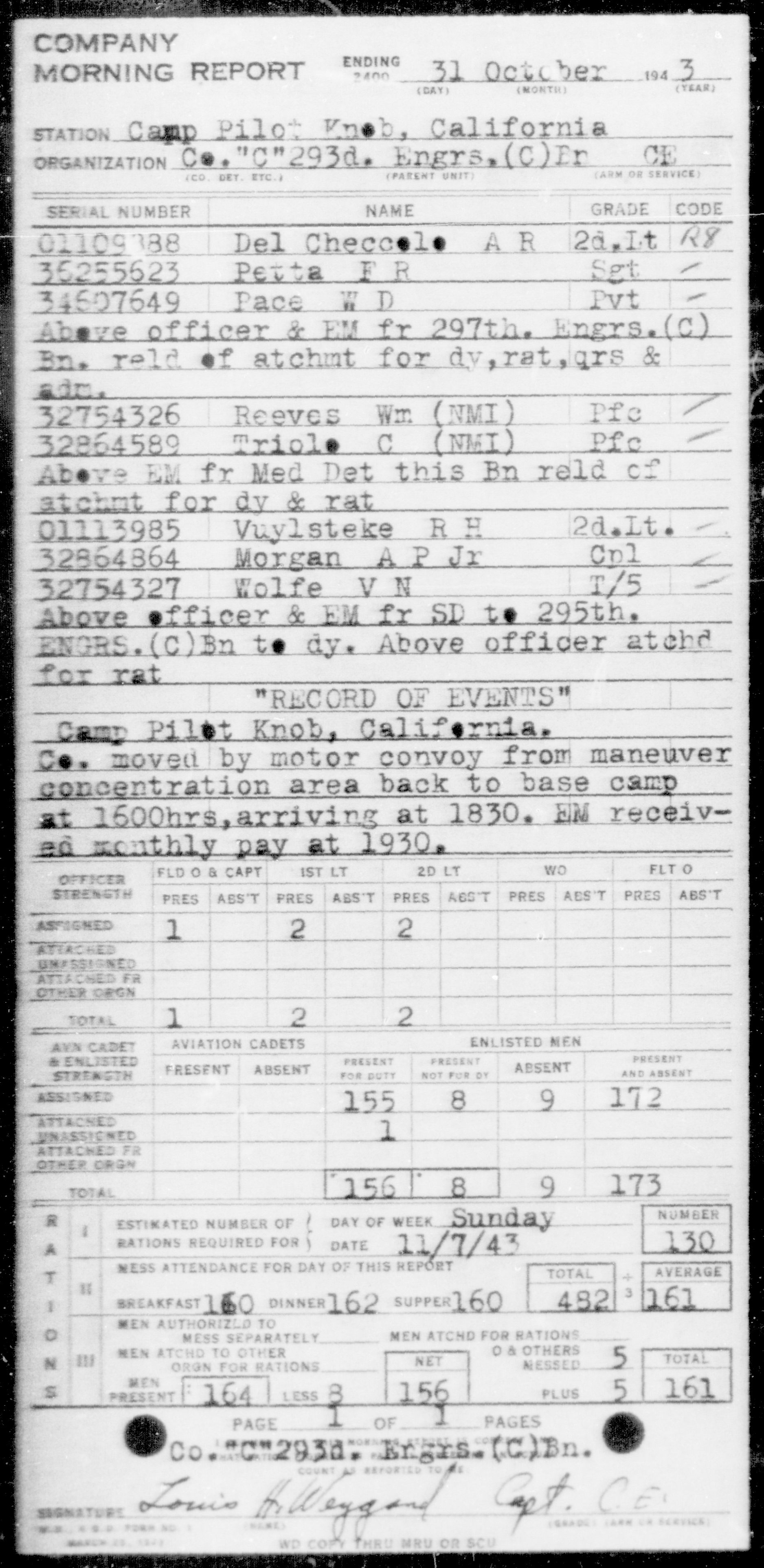
On 23 October Ralph went on special duty with the 295th Engineer Combat Battalion (“fr dy to sp dy to 295th Engrs. (c) Bn.”) while the company “motor convoyed from base camp to bivouac area for desert maneuvers.” On 31 October, at Camp Pilot Knob, California, he is back: “fr SD to 295th. Engrs. (C) Bn to dy”, and the company had “moved by motor convoy from maneuver concentration area back to base camp.”
scanned record
22 September 1943: “Vuylsteke RH 2nd Lt” is the last of the five officers listed. The record of events is the company crating up to leave Camp Forrest. The yellow is ours — it marks his name and service number on the sheet.
scanned record
29 September 1943: tents going up in the desert. His name is the last of the officers. The yellow is ours — it marks his name and service number on the sheet.
scanned record
23 October 1943: special duty with the 295th Engineer Combat Battalion. The yellow is ours — it marks his name and service number on the sheet.
scanned record
31 October 1943, Camp Pilot Knob, California: back to duty with Company C. The yellow is ours — it marks his name and service number on the sheet.
Source: Morning Report — Company C, 293rd Engineer Combat Battalion, APO 402 — NARA Roll 127, part 1 of 4, NAID 449673635, image 796 (September 22, 1943); Morning Report — Company C, 293rd Engineer Combat Battalion, APO 184 — NARA Roll 297, part 2 of 4, NAID 450791337, image 1414 (September 29, 1943); Morning Report — Company C, 293rd Engineer Combat Battalion — NARA Roll 269, part 4 of 4, NAID 452897597, image 3245 (October 23, 1943); image 3253 (October 31, 1943, Camp Pilot Knob, California)
Confirmed — Unit record
December 1, 1943

Desert maneuvers in California

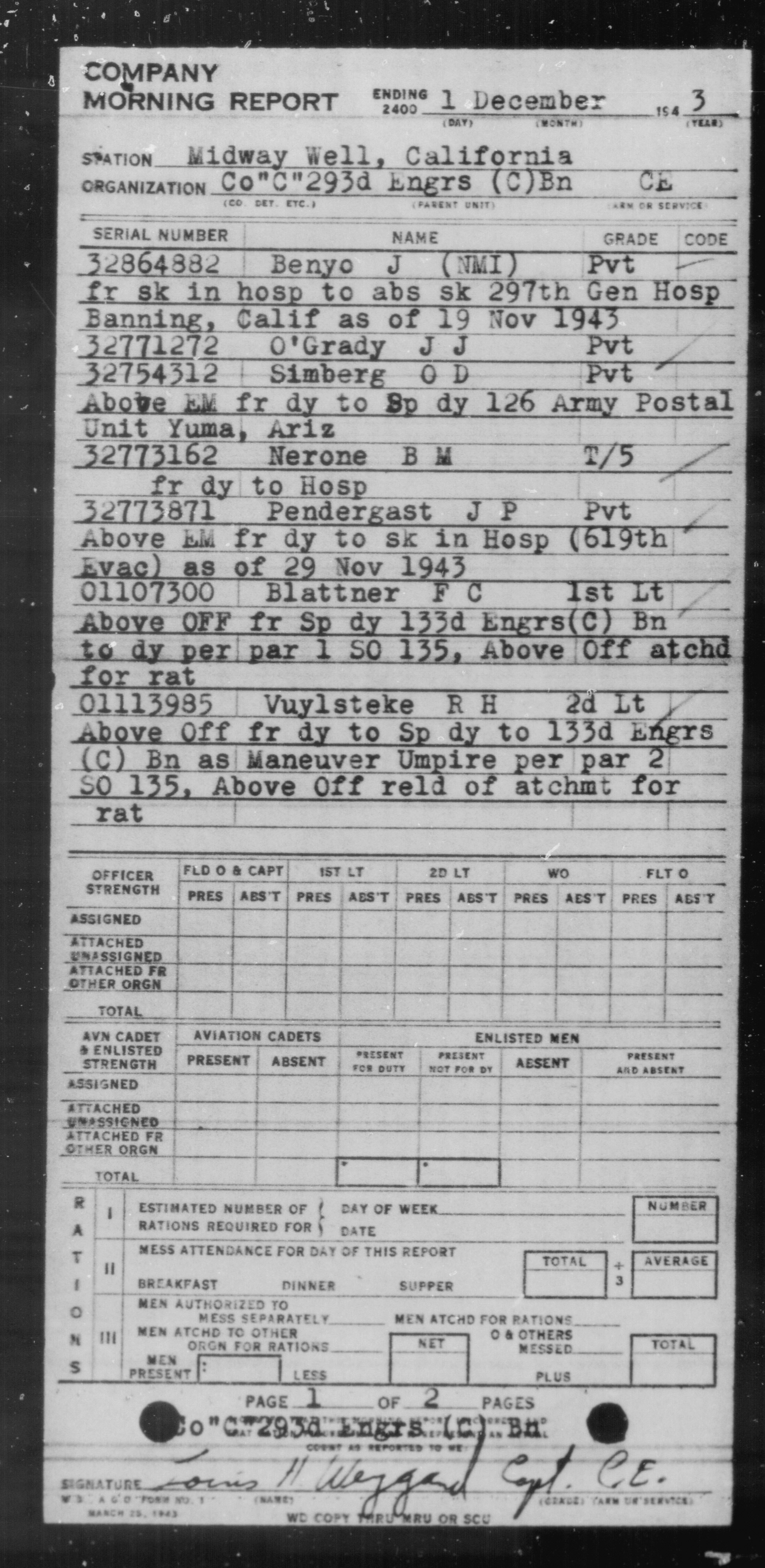
The 293rd is now training in the California–Arizona Maneuver Area, the Army's desert training ground near the Colorado River. Company C, camped at Midway Well, California, reports Ralph “fr dy to Sp dy to 133d Engrs (C) Bn as Maneuver Umpire”. An umpire followed a unit through a training exercise and judged how well it did its job, the way a referee scores a game.
scanned record
Company C's report for 1 December 1943. His entry is at the foot of the list. The yellow is ours — it marks his name and service number on the sheet.
Source: Morning Report — Company C, 293rd Engineer Combat Battalion, Midway Well, California — NARA Roll 29, part 3 of 4, NAID 457755470, image 2696 (December 1, 1943)
Confirmed — Unit record
December 9–11, 1943

Ordered east to Camp Butner, North Carolina

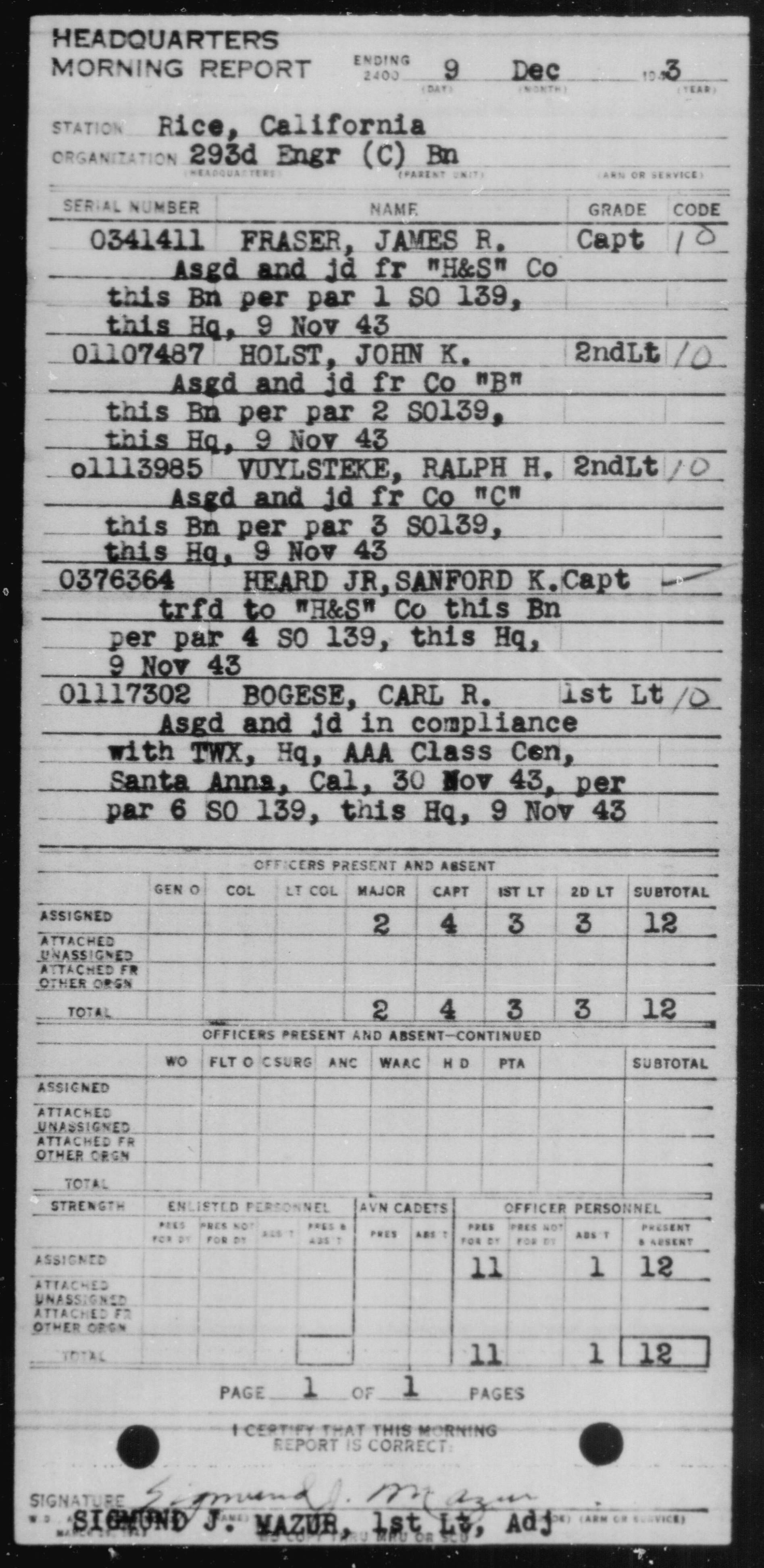
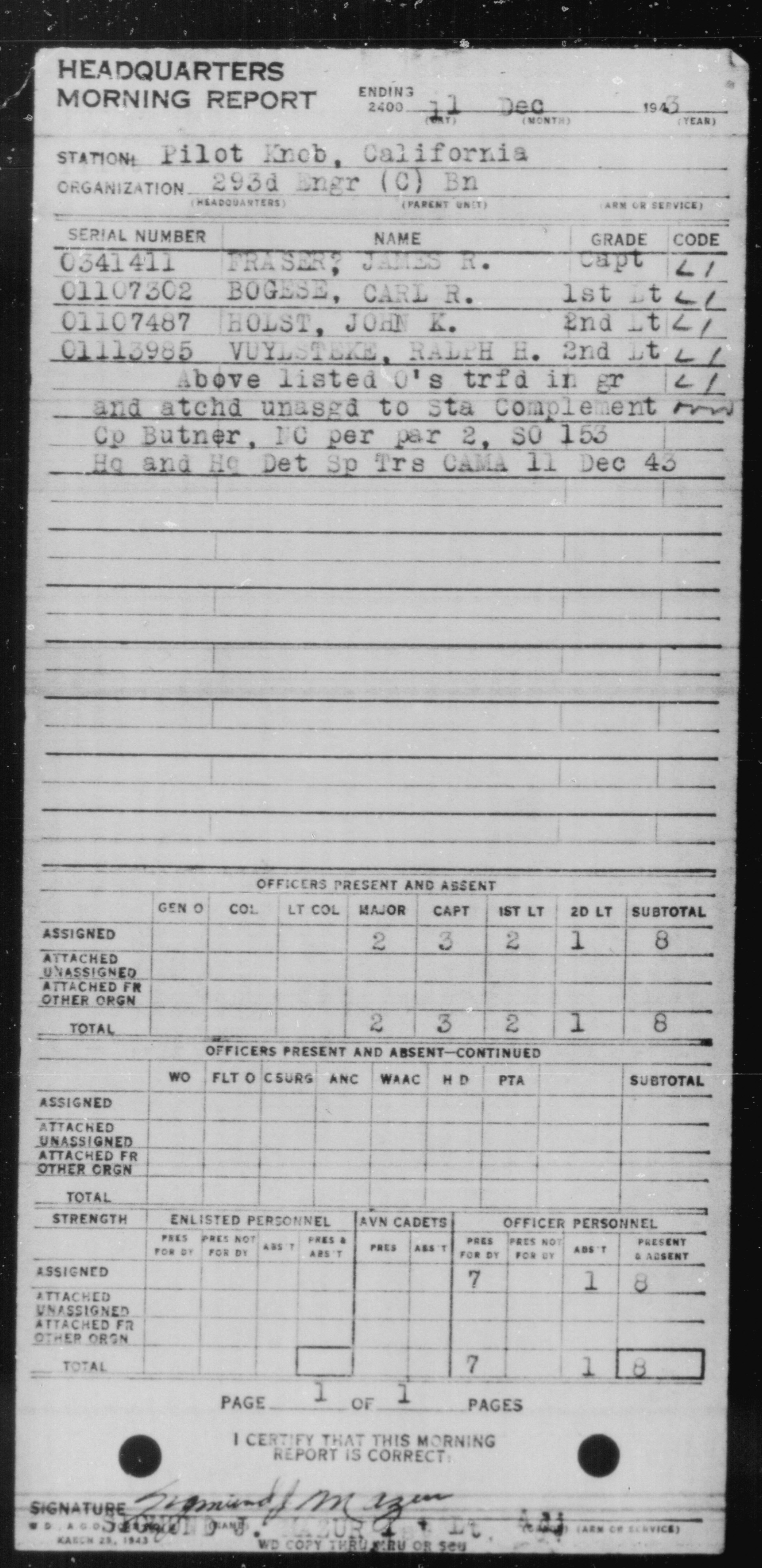
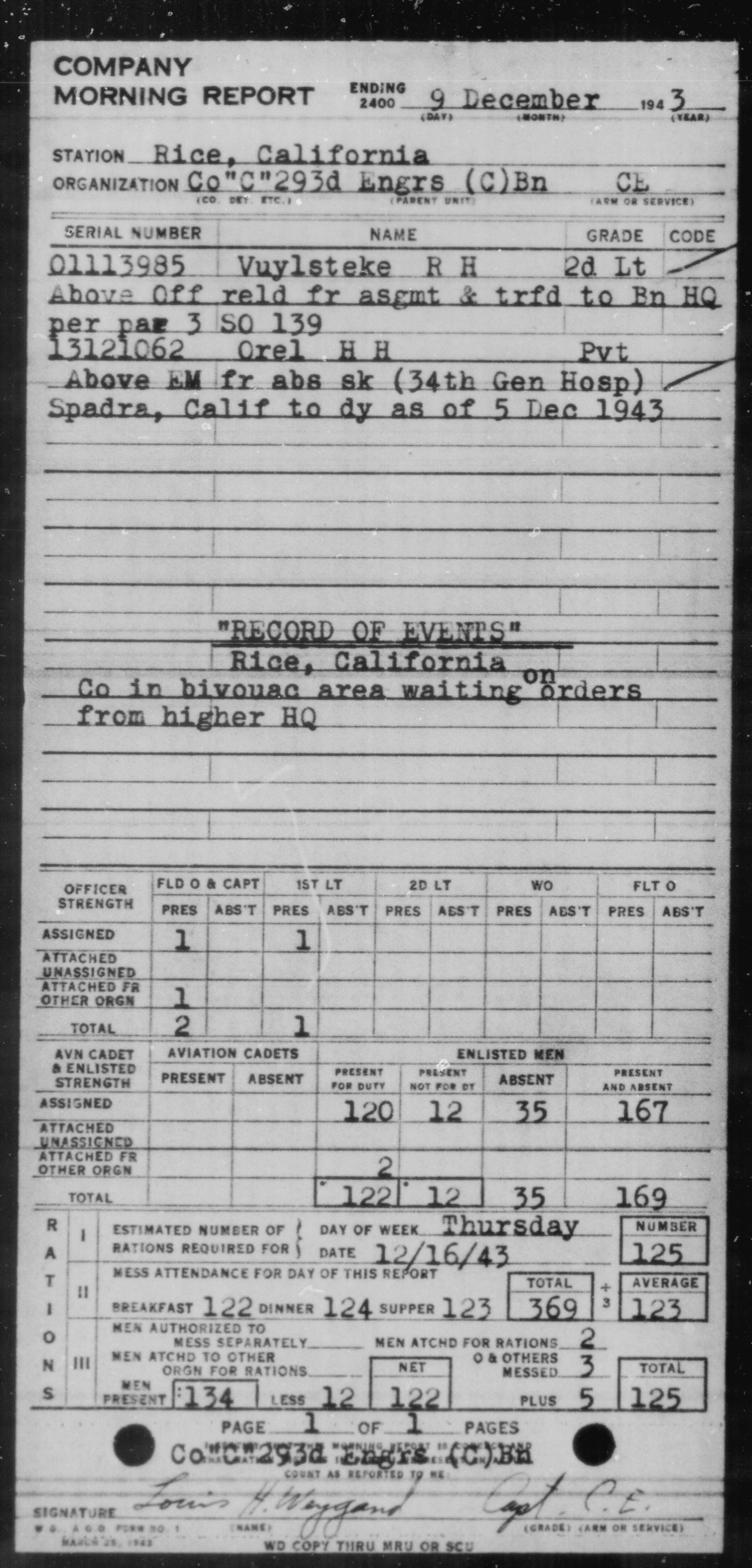
On 9 December, at Rice, California, Company C reports “Vuylsteke R H 2d Lt. Above Off reld fr asgmt & trfd to Bn HQ”, and the battalion's headquarters reports him joined the same day: “VUYLSTEKE, RALPH H. 2ndLt. Asgd and jd fr Co ‘C’ this Bn.”

On 11 December Ralph and three other officers of the 293rd are transferred to the station at Camp Butner, North Carolina. The report, filed at Pilot Knob, California, reads: “Above listed O's trfd in gr and atchd unasgd to Sta Complement Cp Butner, NC.” Four days later he was married in Chicago.
scanned record
Company C, 9 December 1943: relieved and transferred to battalion headquarters. His is the first entry. The yellow is ours — it marks his name and service number on the sheet.
scanned record
Headquarters, 293rd Engineer Combat Battalion, 9 December 1943. His is the third entry. The yellow is ours — it marks his name and service number on the sheet.
scanned record
Headquarters, 293rd Engineer Combat Battalion, 11 December 1943. His is the fourth name. The yellow is ours — it marks his name and service number on the sheet.
Source: Morning Report — Company C, 293rd Engineer Combat Battalion, Rice, California — NARA Roll 29, part 3 of 4, NAID 457755470, image 2708 (December 9, 1943); image 2554 (Headquarters, 293rd Engineer Combat Battalion, December 9, 1943); image 2556 (Headquarters, 293rd Engineer Combat Battalion, Pilot Knob, California, December 11, 1943)
Confirmed — Record
December 15, 1943

Marries Billie Means in Chicago

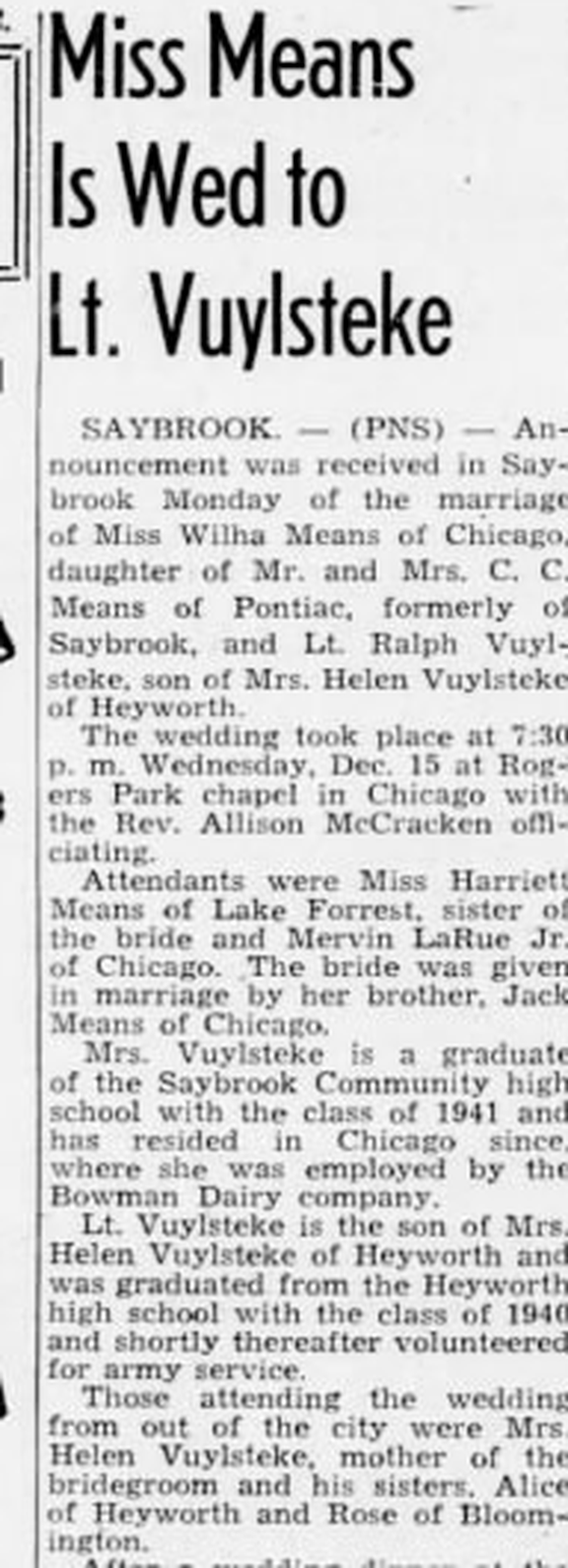
At 7:30 in the evening, at the Rogers Park chapel in Chicago, Ralph marries Wilha Nadine “Billie” Means of Saybrook, Illinois, another McLean County town, twenty miles from Heyworth. The Rev. Allison McCracken officiates. Her brother Jack gives her away; her sister Harriett stands up with her.

Billie had finished at Saybrook Community High School in 1941 and was working in Chicago for the Bowman Dairy Company. His mother came up from Heyworth for the wedding, with his two sisters.

Five days later he reported to a new battalion in North Carolina. They would have four sons: Richard, Les, John and Ken.
scanned record
“Miss Means Is Wed to Lt. Vuylsteke”: the announcement as the Pantagraph printed it a fortnight later. The yellow is ours — it marks his name and service number on the sheet.
Source: The Pantagraph (Bloomington), 29 December 1943, page 6; sons named in the obituary of Billie Vuylsteke, Boardman-Smith Funeral Chapel, 2011: https://web.archive.org/web/20221207191132/https://www.boardmansmith.com/obituaries/Billie-Vuylsteke?obId=8549293
Confirmed — Unit record
December 20, 1943

Camp Butner, North Carolina: the 283rd Engineer Combat Battalion

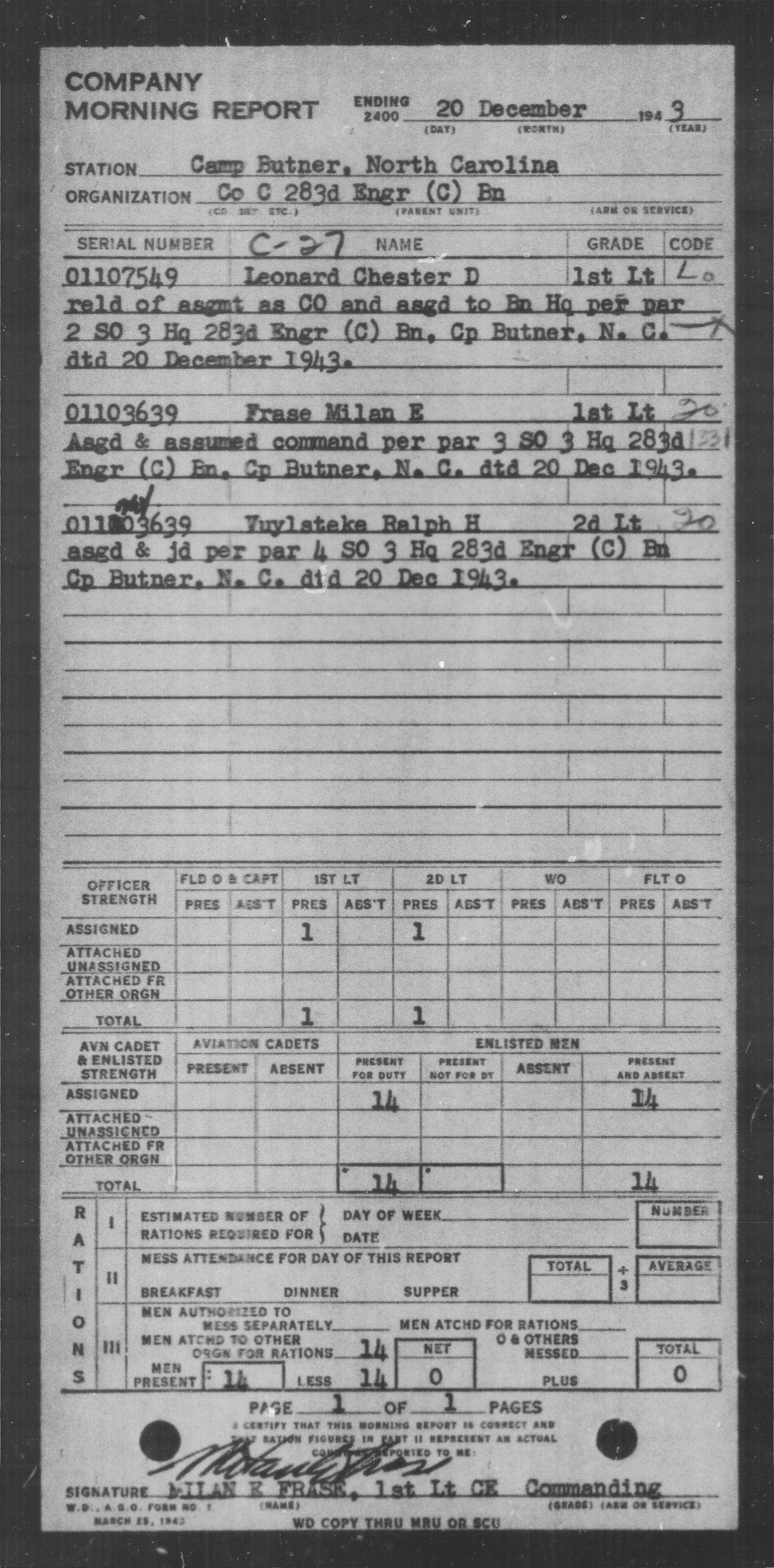
Ralph is assigned to Company C, 283rd Engineer Combat Battalion. That day the company had two officers and fourteen enlisted men, and Ralph was one of the two officers.

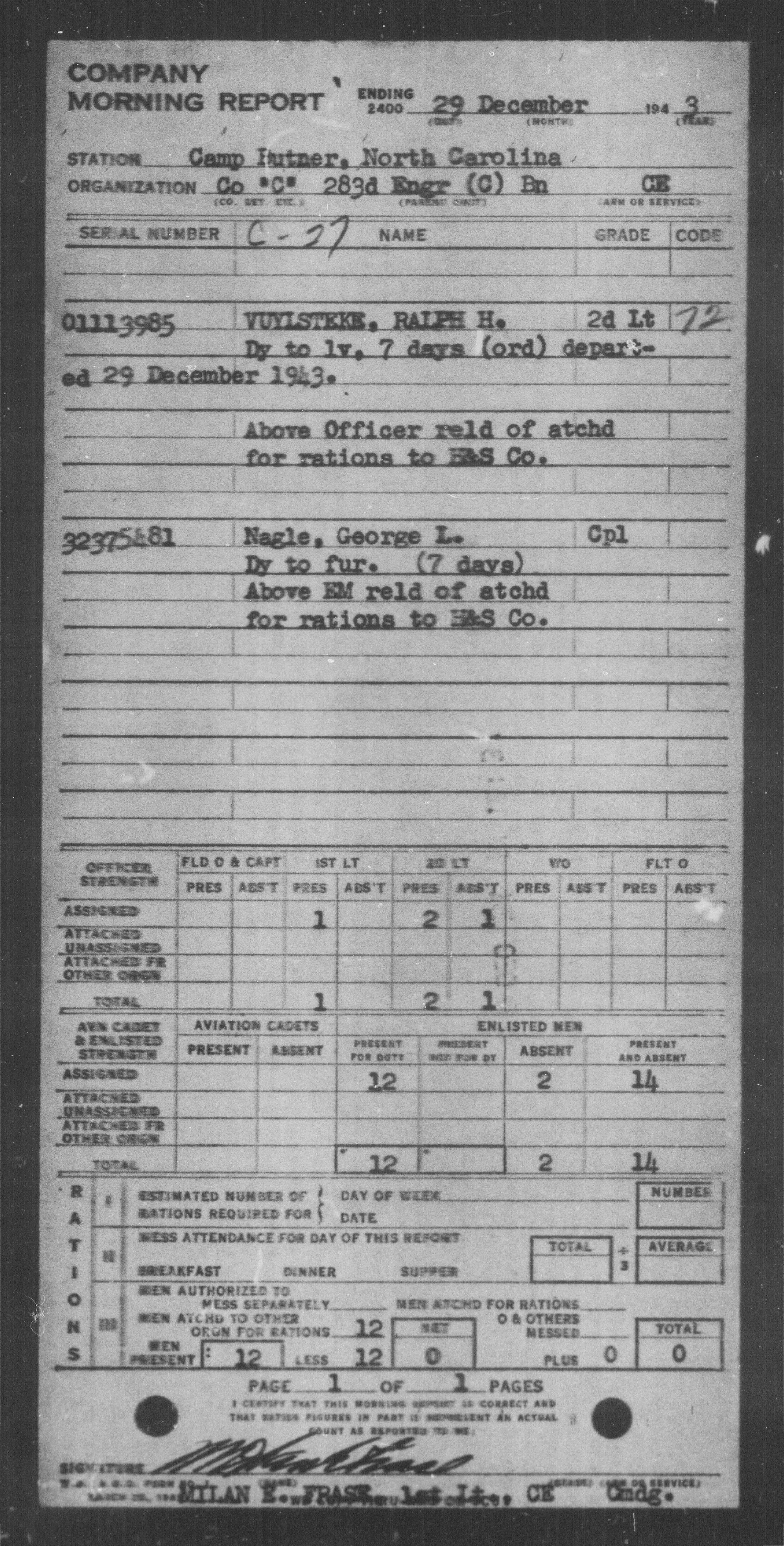
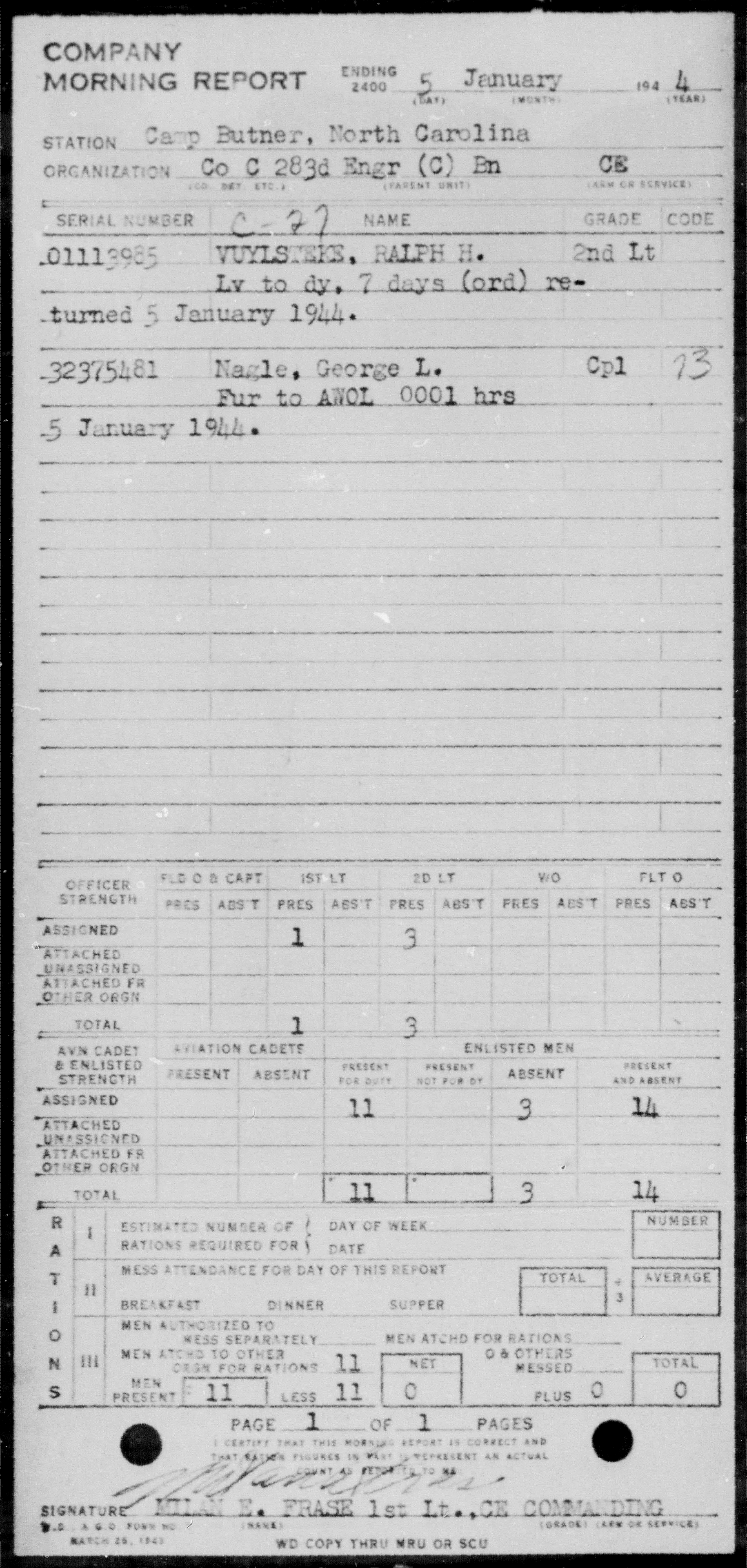
On 29 December the company reports “VUYLSTEKE, RALPH H. 2d Lt. Dy to lv, 7 days (ord) departed 29 December 1943”, seven days' ordinary leave, and on 5 January 1944 “Lv to dy, 7 days (ord) returned 5 January 1944.”
scanned record
20 December 1943: the company report names Ralph among its newly assigned officers. The yellow is ours — it marks his name and service number on the sheet.
scanned record
29 December 1943: seven days' ordinary leave. His is the first entry. The yellow is ours — it marks his name and service number on the sheet.
scanned record
5 January 1944: back from leave to duty. The yellow is ours — it marks his name and service number on the sheet.
Source: Morning Report — Company C, 283rd Engineer Combat Battalion, Camp Butner, North Carolina — NARA Roll 270, part 4 of 4, NAID 458482772, image 3049 (December 20, 1943); image 3058 (December 29, 1943); Morning Report — Company C, 283rd Engineer Combat Battalion — NARA Roll 331, part 4 of 4, NAID 461105950, image 3178 (January 5, 1944)
Context
December 1943

His family, in the wedding notice

The wedding notice names his family. He is “son of Mrs. Helen Vuylsteke of Heyworth”, and among the guests from out of town were his mother and “his sisters, Alice of Heyworth and Rose of Bloomington”. His father, Harry, had died in 1925.

It also explains how he came to be in uniform so early. He “was graduated from the Heyworth high school with the class of 1940 and shortly thereafter volunteered for army service”, which matches his National Guard enlistment on 2 July 1940, a few weeks after he left school.
Source: The Pantagraph (Bloomington), 29 December 1943, page 6
Confirmed — Unit record
February 2, 1944

Transfers to battalion headquarters

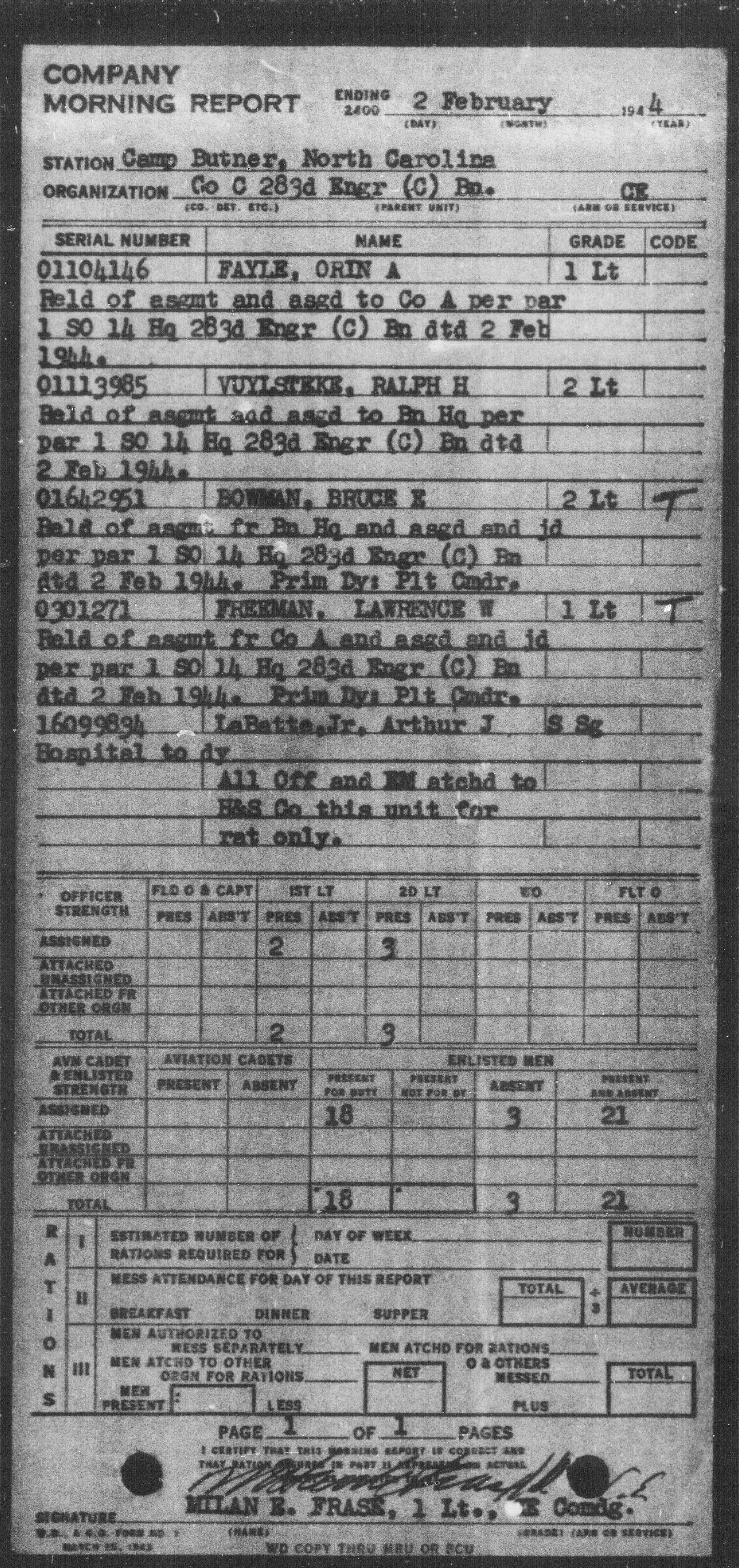
Company C's Morning Report shows “01113985 VUYLSTEKE, RALPH H, 2 Lt, Reld of asgmt and asgd to Bn Hq”: relieved from Company C and assigned to the headquarters of the 283rd Engineer Combat Battalion at Camp Butner. He serves there for the next twelve weeks.
scanned record
Company C's report for 2 February 1944. His is the second entry. The yellow is ours — it marks his name and service number on the sheet.
Source: Morning Report — Company C, 283rd Engineer Combat Battalion, Camp Butner, North Carolina — NARA Roll 307, part 4 of 4, NAID 463523353, image 3021 (February 2, 1944)
Confirmed — Unit record
April 26, 1944

Ordered to the 179th Engineer Combat Battalion
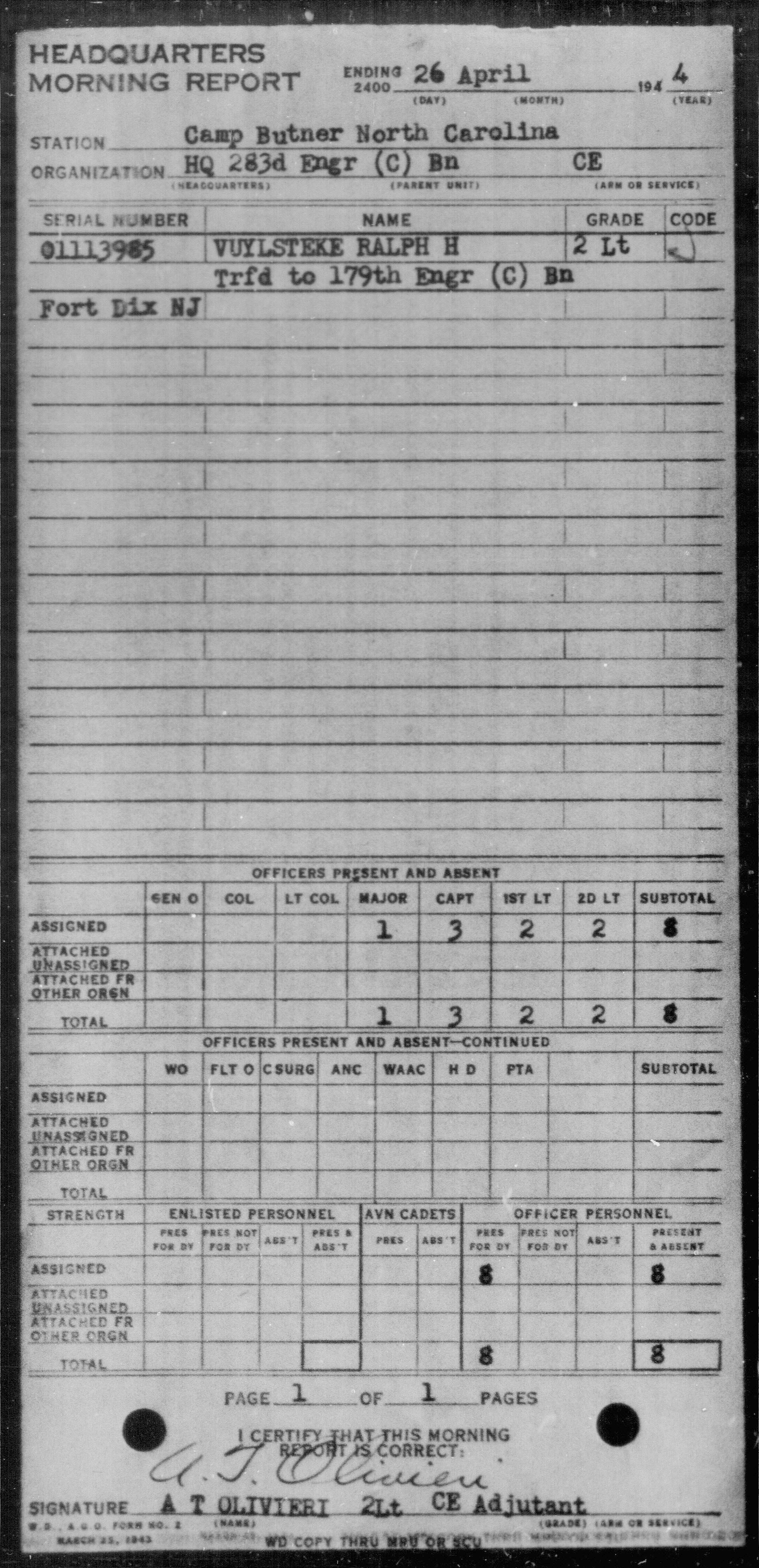
The 283rd's headquarters reports him out: “01113985 VUYLSTEKE RALPH H, 2 Lt, Trfd to 179th Engr (C) Bn, Fort Dix NJ.” Transferred to the 179th Engineer Combat Battalion at Fort Dix, New Jersey.
scanned record
The transfer out, 26 April 1944. The yellow is ours — it marks his name and service number on the sheet.
Source: Morning Report — Headquarters, 283rd Engineer Combat Battalion, Camp Butner, North Carolina — NARA Roll 298, part 4 of 4, NAID 468287285, image 3608 (April 26, 1944)
Confirmed — Unit record
April 27, 1944

Fort Dix, New Jersey: Company B, 179th Engineer Combat Battalion

He joins the battalion he will serve with for the rest of the war, and the report sets down his particulars: component Army of the United States, date of rank 12 May 1943, principal duty: Administrative Officer. An administrative officer handled a company's paperwork, records and personnel matters.

The 179th had reached Fort Dix a month earlier, straight off maneuvers in the West Virginia mountains, to finish training before going overseas.
scanned record
His joining report, with his date of rank and his duty. The yellow is ours — it marks his name and service number on the sheet.
Source: Morning Report — Company B, 179th Engineer Combat Battalion, Fort Dix, New Jersey — NARA Roll 295, part 1 of 4, NAID 468273423, image 238 (April 28, 1944)
Confirmed — Unit record
June 30, 1944

Loading officer, then overseas with Company B

On D-Day the 179th was still at Fort Dix, building a narrow-gauge railroad. On 16 June it moved to Camp Kilmer, New Jersey, the staging camp for the New York port.

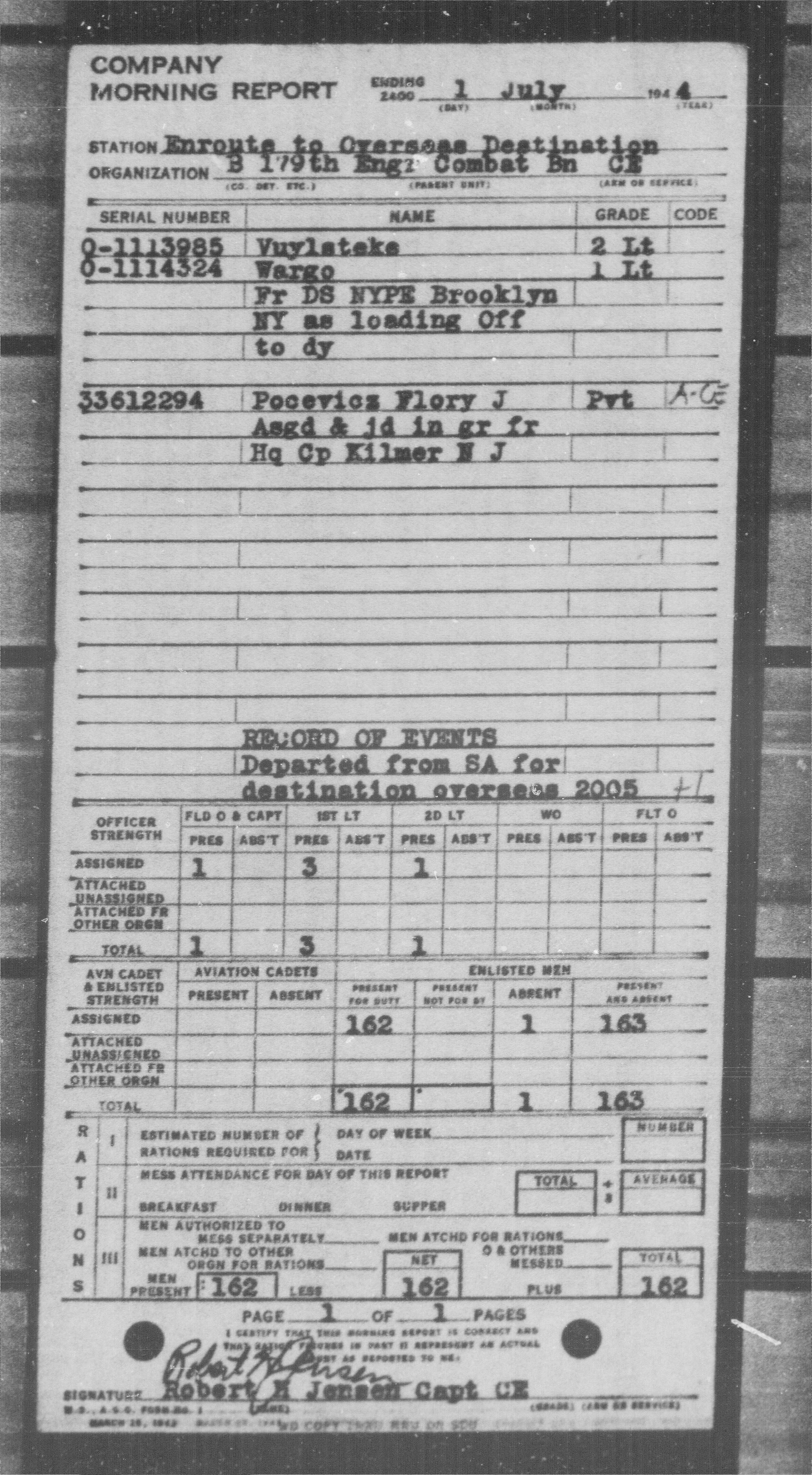
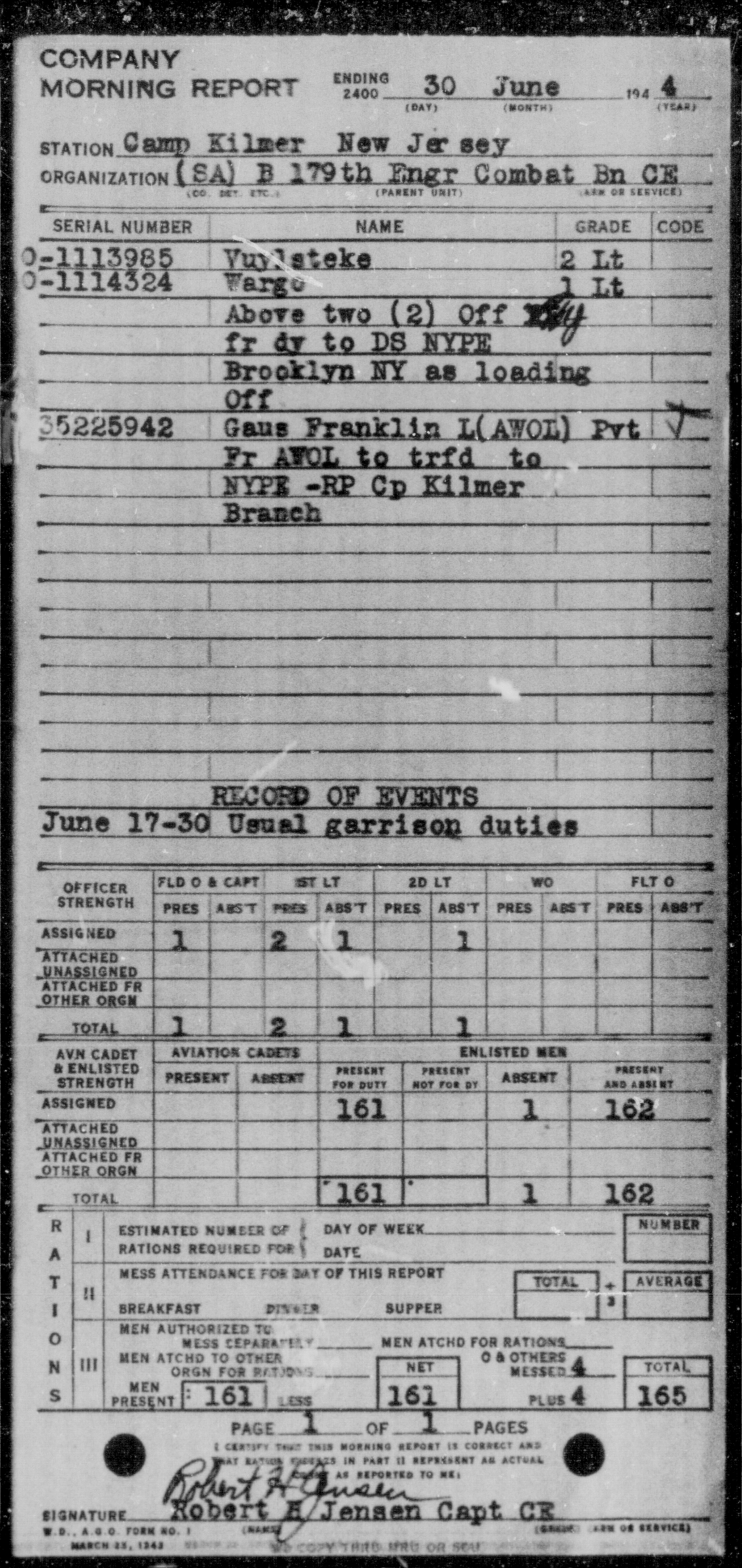
On 30 June Company B reports “0-1113985 Vuylsteke 2 Lt, 0-1114324 Wargo 1 Lt. Above two (2) Off fr dy to DS NYPE Brooklyn NY as loading Off”: Ralph and First Lieutenant Wargo are sent to the New York Port of Embarkation in Brooklyn as loading officers, the men who saw the company's soldiers and equipment aboard ship. On 1 July both return to the company, and its report reads “Enroute to Overseas Destination” and “Departed from SA for destination overseas 2005”: the company left its staging area at 8:05 that evening. Ralph is the company's only second lieutenant.

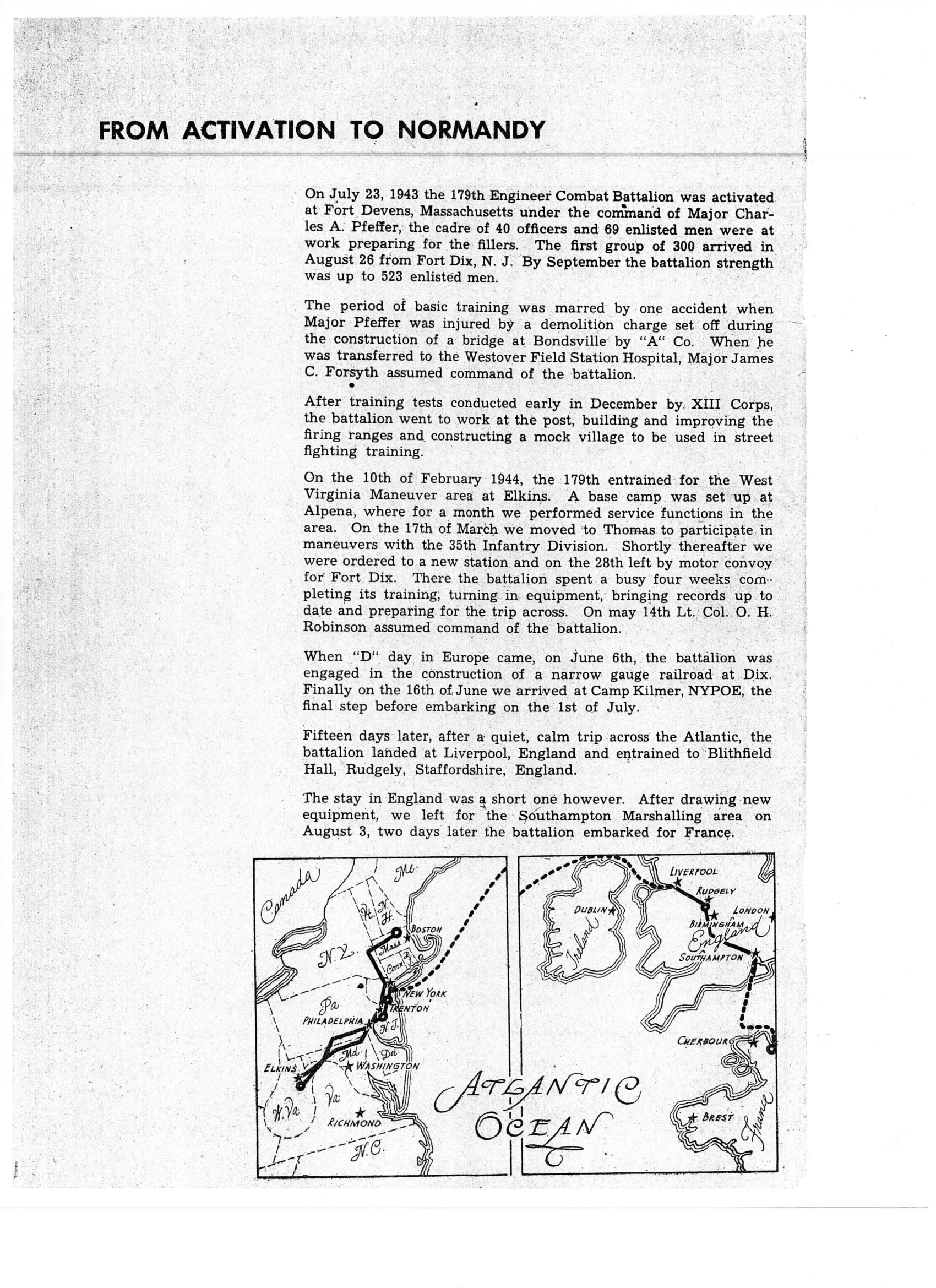
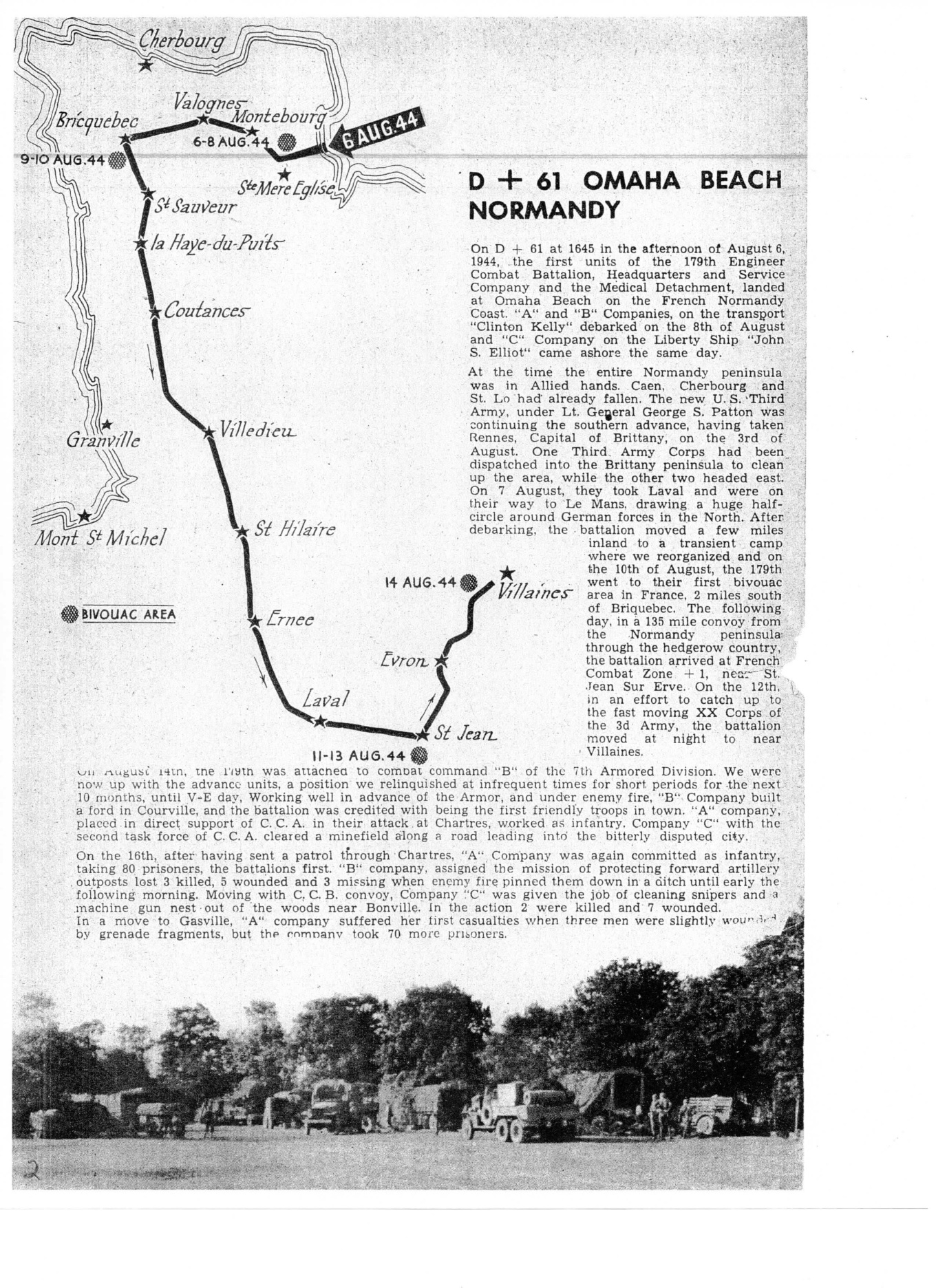
The battalion's history continues the story: Headquarters came ashore at Omaha Beach, Normandy, on 6 August, and Company B landed on 8 August from the transport Clinton Kelly. These landing dates describe the company and battalion movements in the unit history.
scanned record
30 June 1944: Ralph and Lt. Wargo sent to the New York Port of Embarkation as loading officers. The yellow is ours — it marks his name and service number on the sheet.
scanned record
1 July 1944: “Enroute to Overseas Destination.” His name is the first entry. The yellow is ours — it marks his name and service number on the sheet.
scanned record
“From Activation to Normandy”, the battalion's own account of its first year and its landing in France.
scanned record
The battalion history, part 1, PDF page 6: Company B landed from the Clinton Kelly on 8 August 1944.
Source: Morning Report — Company B, 179th Engineer Combat Battalion, Camp Kilmer, New Jersey — NARA Roll 390, part 3 of 4, NAID 477528634, image 2919 (June 30, 1944); Morning Report — Company B, 179th Engineer Combat Battalion — NARA Roll 566, part 2 of 5, NAID 480769321, image 1159 (July 1, 1944); 179th Engineer Combat Battalion, battalion history (unit publication), part 1, PDF pages 5–6: https://ww2combatengineers.com/wp-content/uploads/docs/179th%20Engineers/179thPart1.pdf
Context
August 1944

England, then across France with Patton's Third Army

The battalion's history fills in the crossing. “Fifteen days later” the men landed at Liverpool and went by train to Blithfield Hall, near Rugeley in Staffordshire, England. On 3 August they moved to Southampton to cross to France.

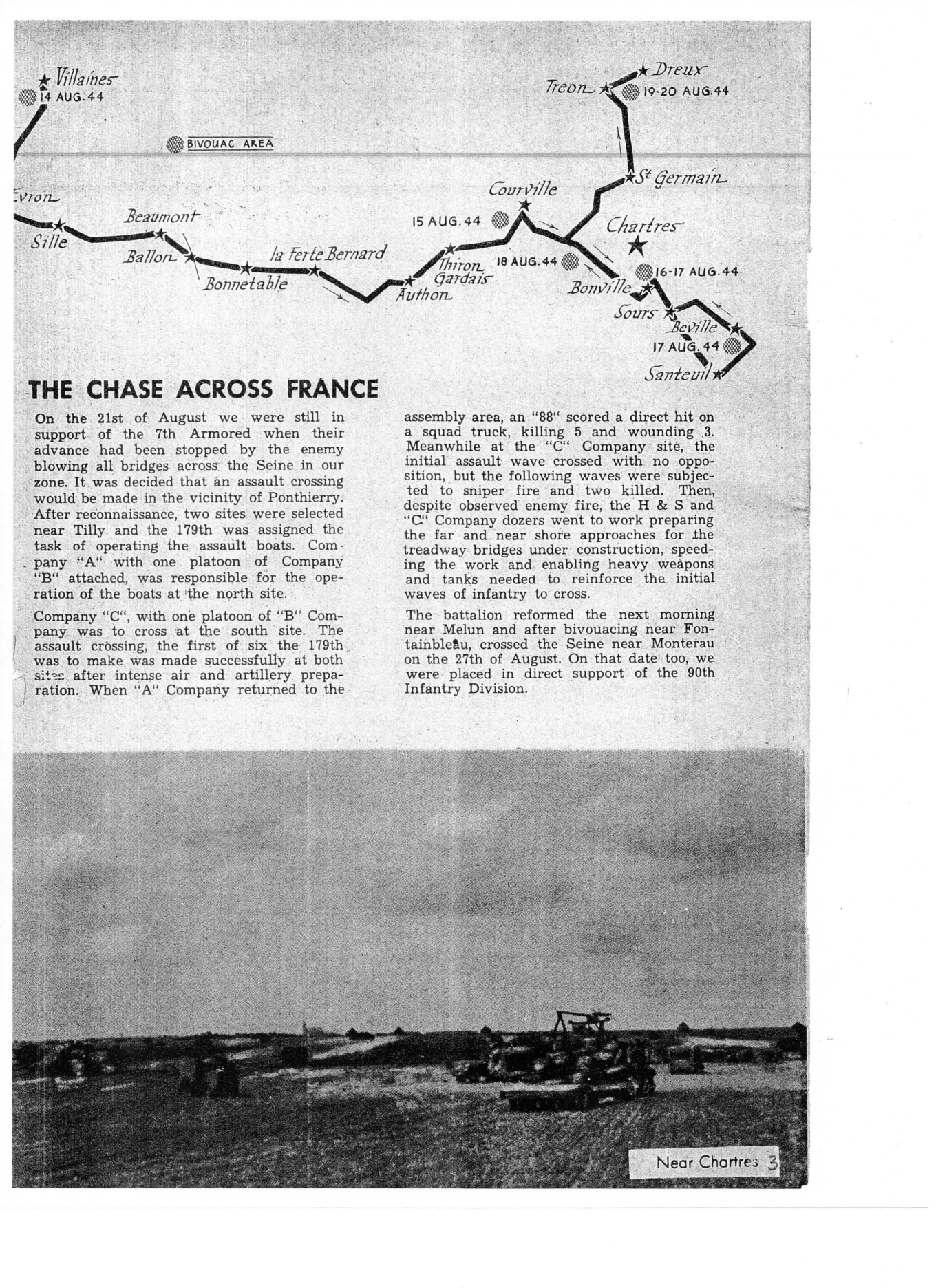
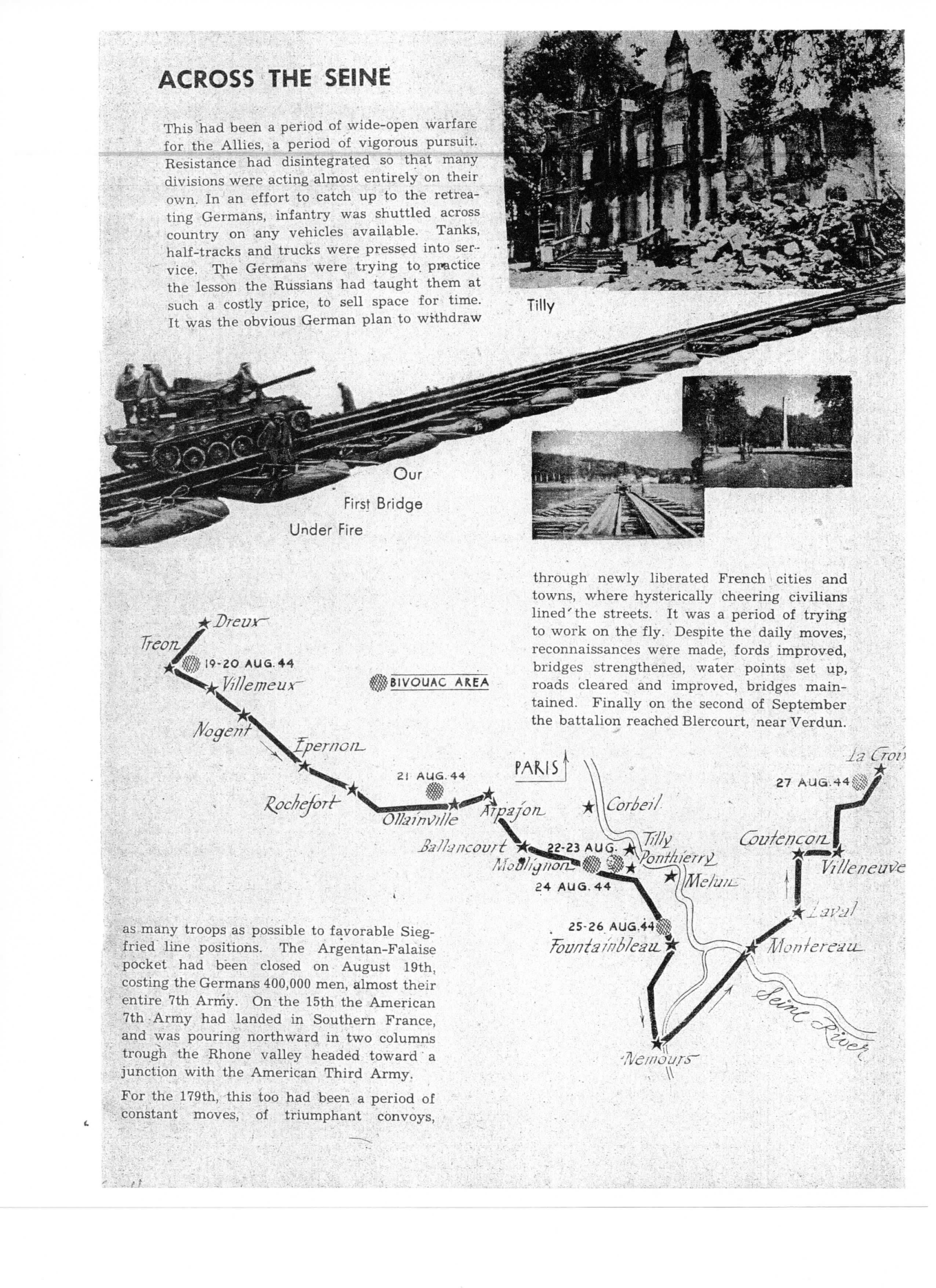
Once ashore in Normandy the battalion moved inland with General Patton's Third Army, in what its history calls “the fast moving XX Corps of the 3d Army”. On 14 August it joined Combat Command B of the 7th Armored Division. On 21 August it made an assault crossing of the Seine near Ponthierry, the first of six assault crossings it would make, and a platoon of Company B manned the assault boats at each crossing site.

By 2 September the battalion had reached Blercourt, near Verdun.
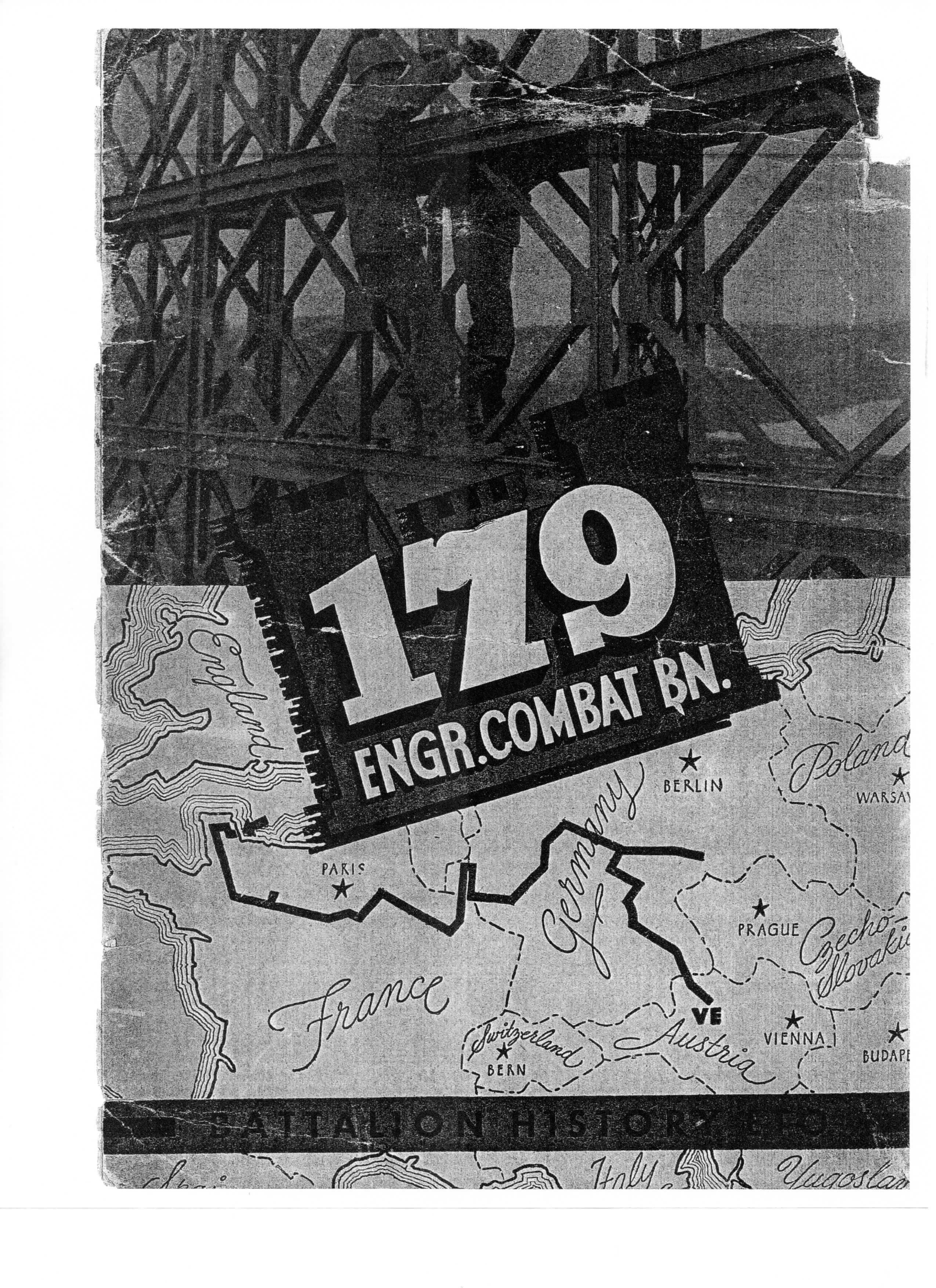
scanned record
The route map from the cover of the battalion's own history: England, France, Germany, and Austria, where the war ended for them.
scanned record
The unit history, part 1, PDF page 7: the Seine crossing.
scanned record
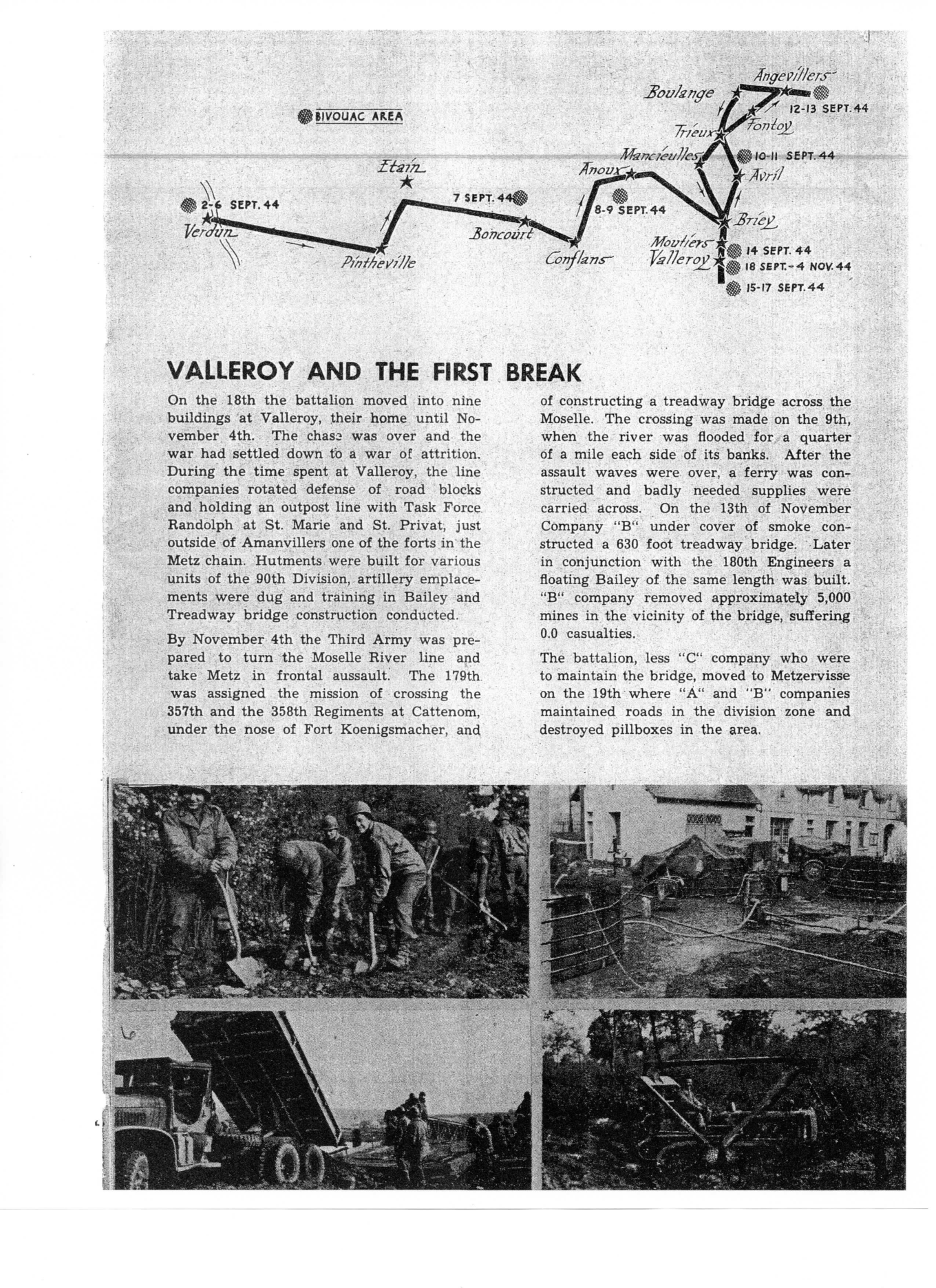
Part 1, PDF page 8: the battalion reached Blercourt near Verdun on 2 September.
Source: 179th Engineer Combat Battalion, battalion history, part 1, PDF pages 5–8: https://ww2combatengineers.com/wp-content/uploads/docs/179th%20Engineers/179thPart1.pdf
Context
December 6, 1944

Autumn 1944: the Moselle, and the first step into Germany

Through the autumn the battalion worked its way toward Germany. In November, at Cattenom on the Moselle River, Company B built a 630-foot treadway bridge and lifted about 5,000 mines.

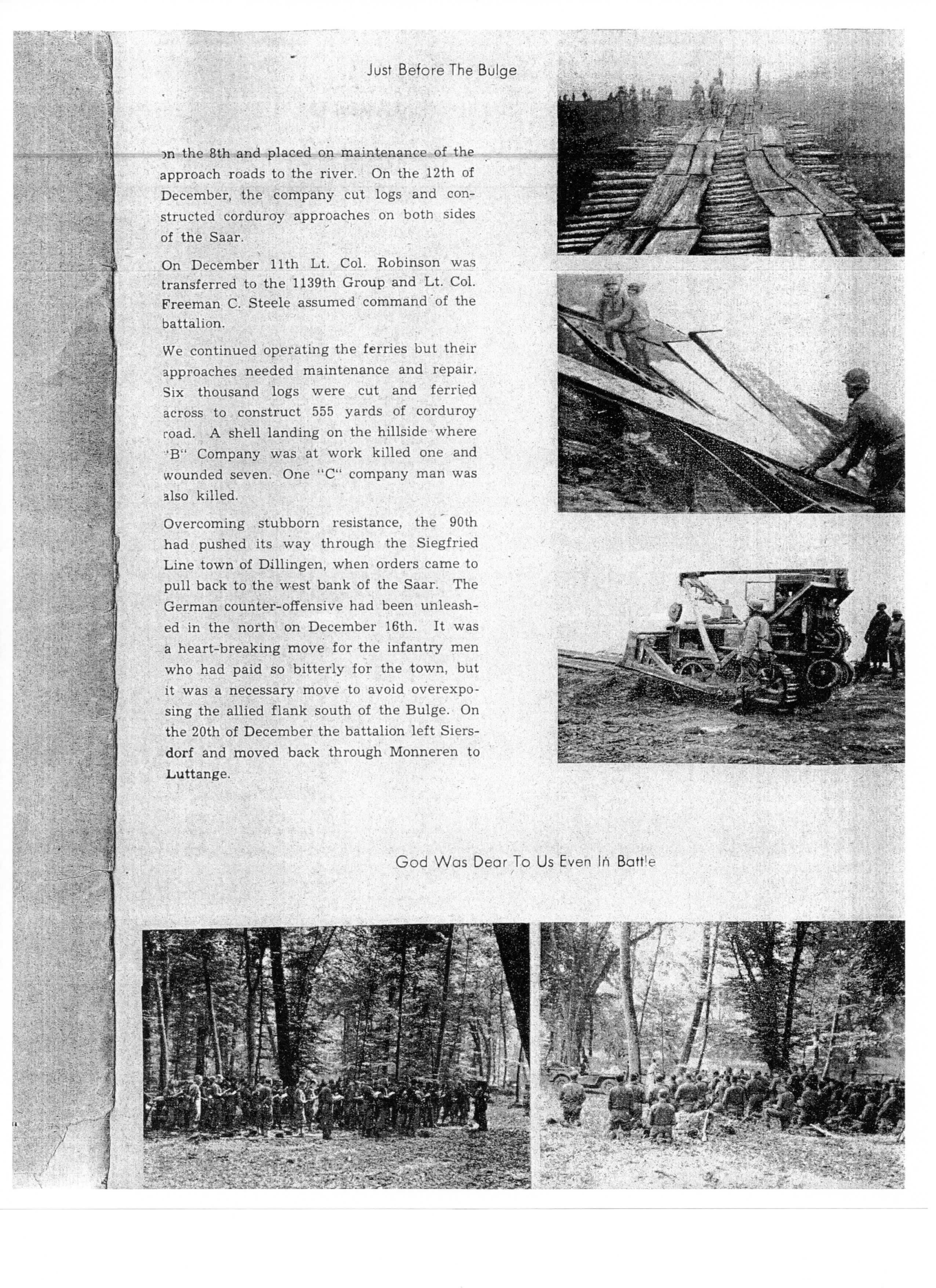
On the morning of 6 December, Company B ferried the lead companies of the 2nd Battalion, 357th Infantry, 90th Infantry Division, across the Saar River near Dillingen. The history calls it “the first step in Germany.” An enemy shell killed one man of Company B and wounded seven.

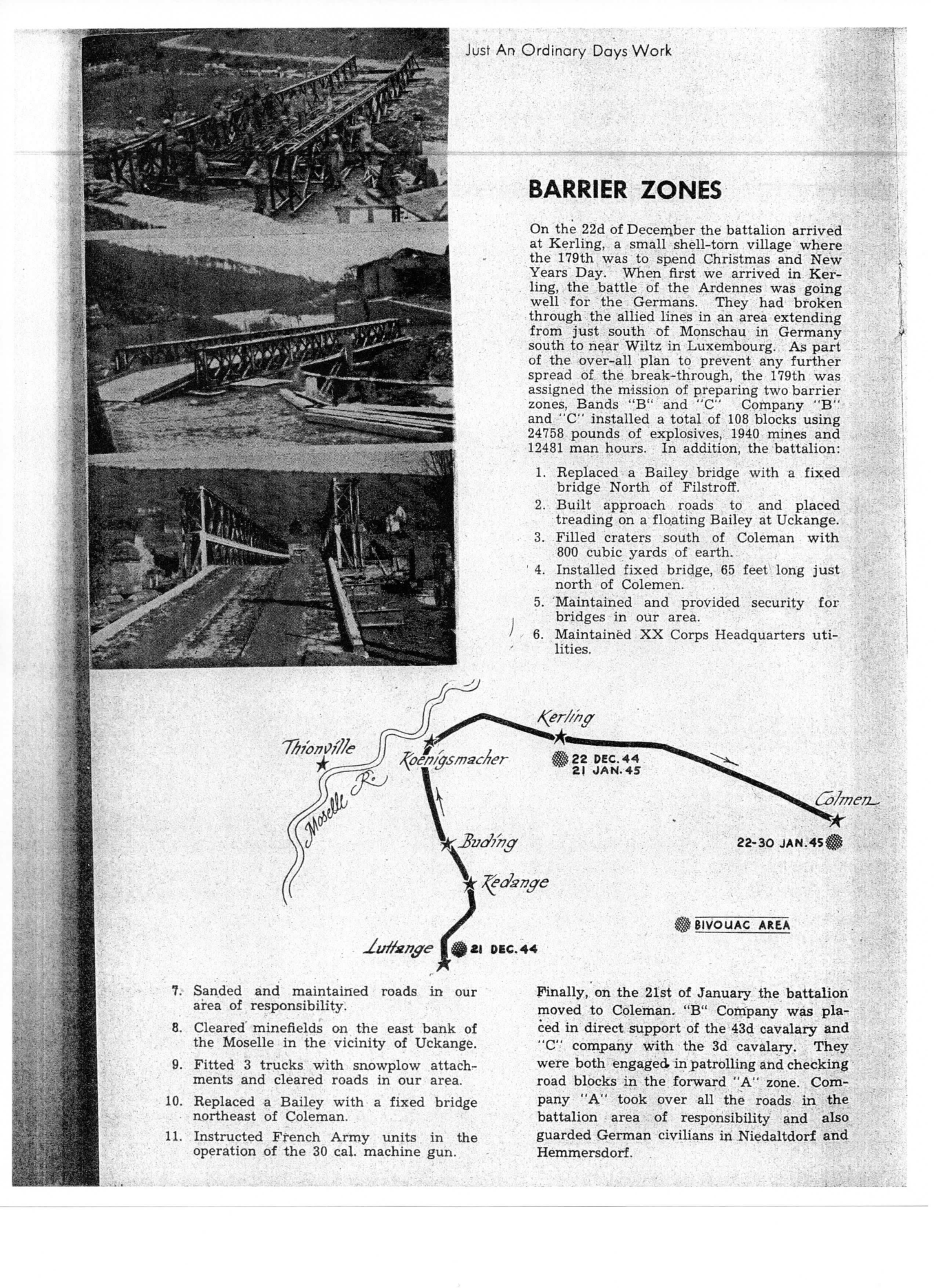
When the Germans attacked in the Ardennes, the Battle of the Bulge, the battalion was pulled back on 20 December, and it spent Christmas at Kerling, in France, building defensive barriers.
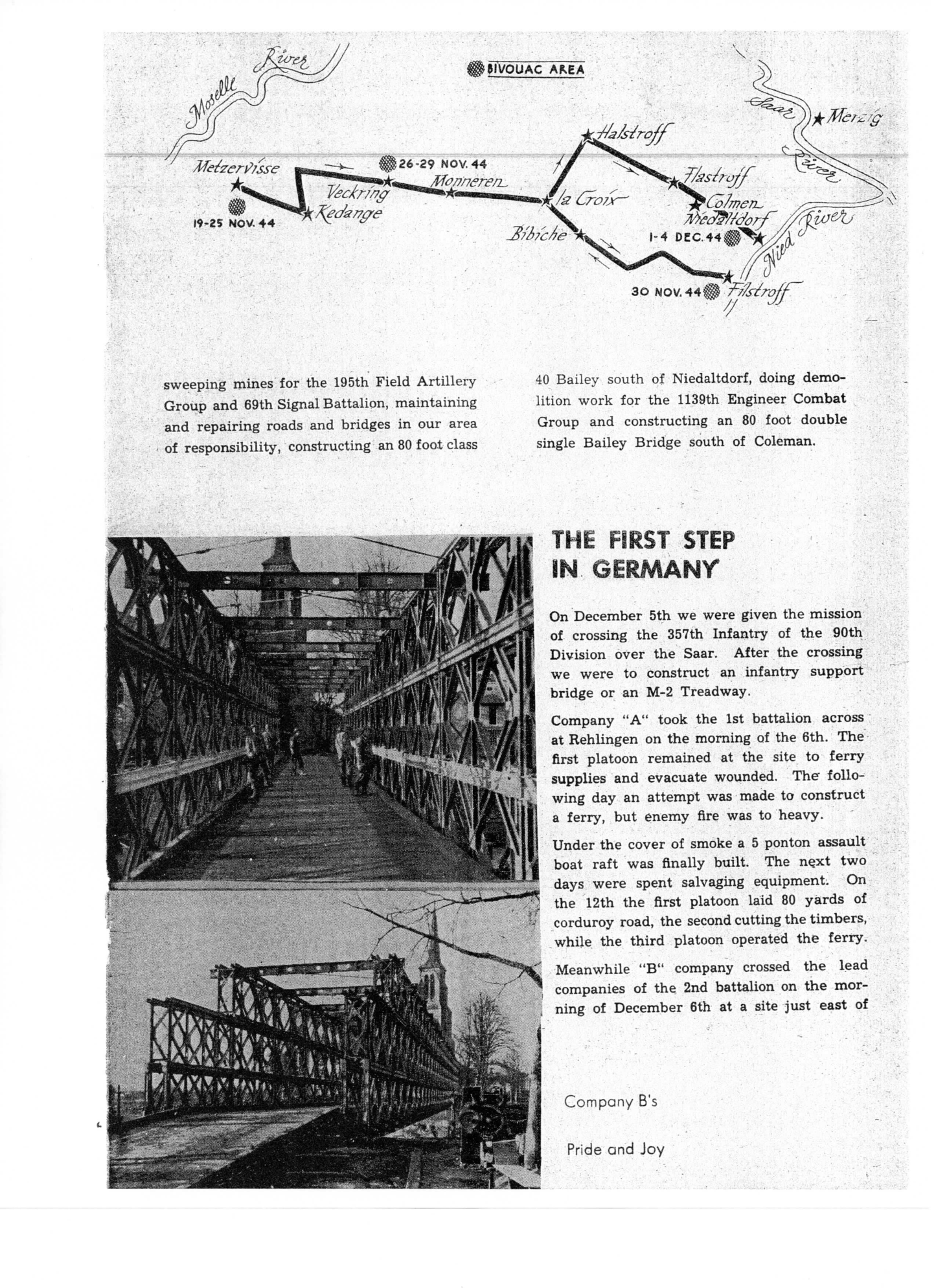
scanned record
“The First Step in Germany”: the battalion's account of the Saar crossing of 6 December 1944, with Company B's Bailey bridge, “Company B's Pride and Joy.”
scanned record
Part 1, PDF page 10: Company B's Moselle bridge and mine-clearing work.
scanned record
Part 1, PDF page 14: December casualties and withdrawal.
scanned record
Part 1, PDF page 15: the battalion at Kerling for Christmas.
Source: 179th Engineer Combat Battalion, battalion history, part 1, PDF pages 10, 12–15: https://ww2combatengineers.com/wp-content/uploads/docs/179th%20Engineers/179thPart1.pdf
Context
February 23, 1945

The Saar: the day of his Bronze Star

This is the date on Ralph's citation, and the battalion's history shows what the 179th was doing that week.

From Elzange the battalion went into direct support of the 10th Armored Division, clearing the Saar–Moselle Triangle and then crossing the Saar River to break into the Siegfried Line, Germany's border fortifications. Forward command posts went up at Tawern, then Ayl. “It was the 179th's job to ferry badly needed supplies and reinforcements. Company “A” was placed in direct support of C.C.A. Company “B” with C.C.B. In trying to construct the ferry, the men met with some of the most intense enemy fire yet encountered.” C.C.A. and C.C.B. were the division's Combat Commands A and B. “94 floats were needed to put a 5 float raft in the water.” On 25 February the battalion was relieved of the crossing “for a badly needed rest period.”

Ralph was serving in Company B, and his citation honors his work on this day. The award order identifies Germany and the date; it does not describe Ralph's individual actions or name the river-crossing site.
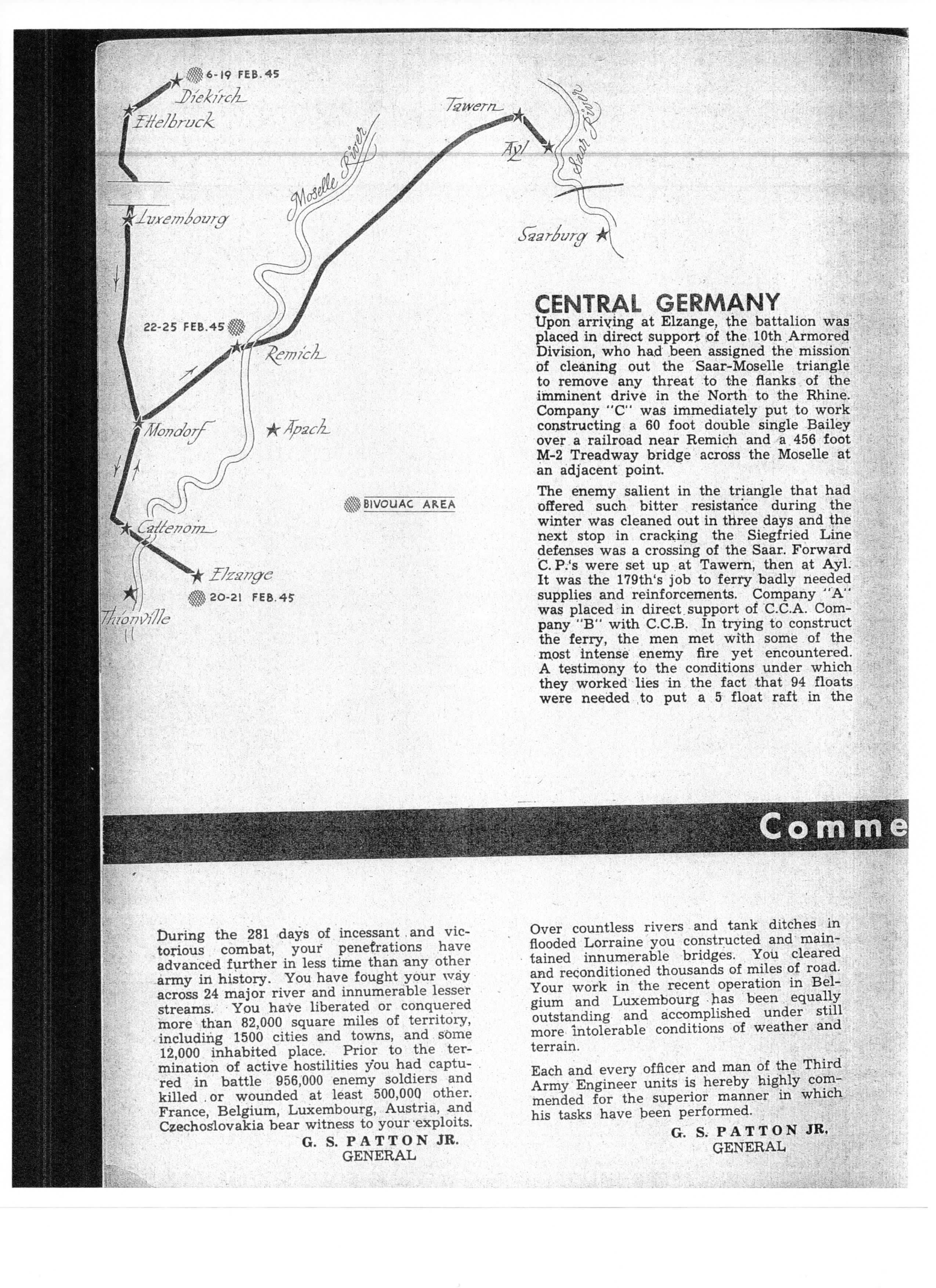
scanned record
The battalion's account of the Saar crossing, with its route map: Elzange 20–21 February, Remich 22–25 February 1945.
Source: 179th Engineer Combat Battalion, battalion history, part 1, PDF page 17: https://ww2combatengineers.com/wp-content/uploads/docs/179th%20Engineers/179thPart1.pdf; General Orders No. 71, Headquarters XX Corps, 18 May 1945, page 2, NAID 373989135
Confirmed — Unit record
1945: the battalion history

First Lieutenant, 2nd Platoon Commander, Company B

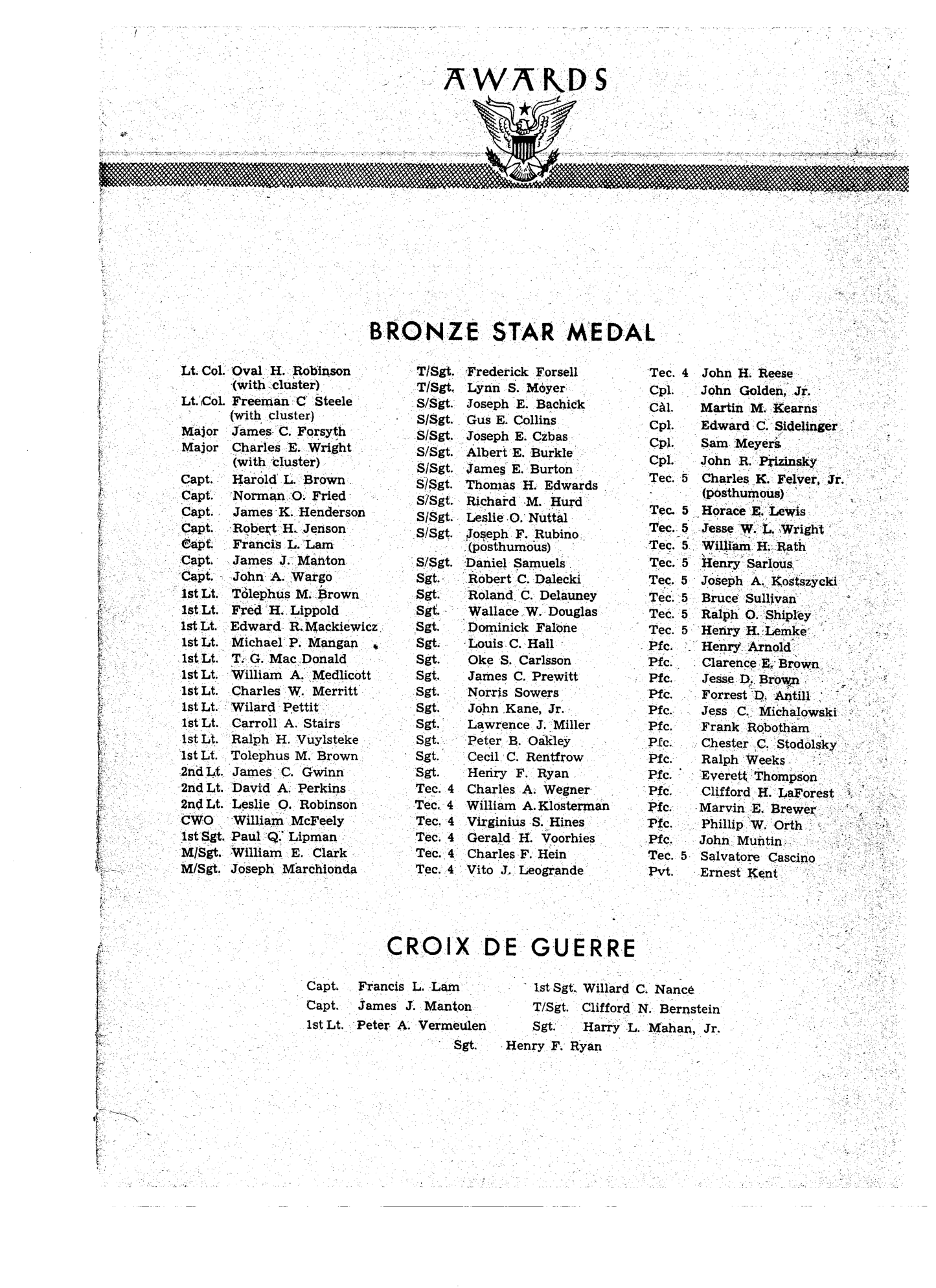
The battalion's history lists Company B's officers under its commander, Captain Robert H. Jensen: “2nd Platoon Commander, 1st Lt. Ralph H. Vuylsteke.” He led one of the company's three platoons. The same history names him on the battalion's roll of Bronze Star Medal recipients.

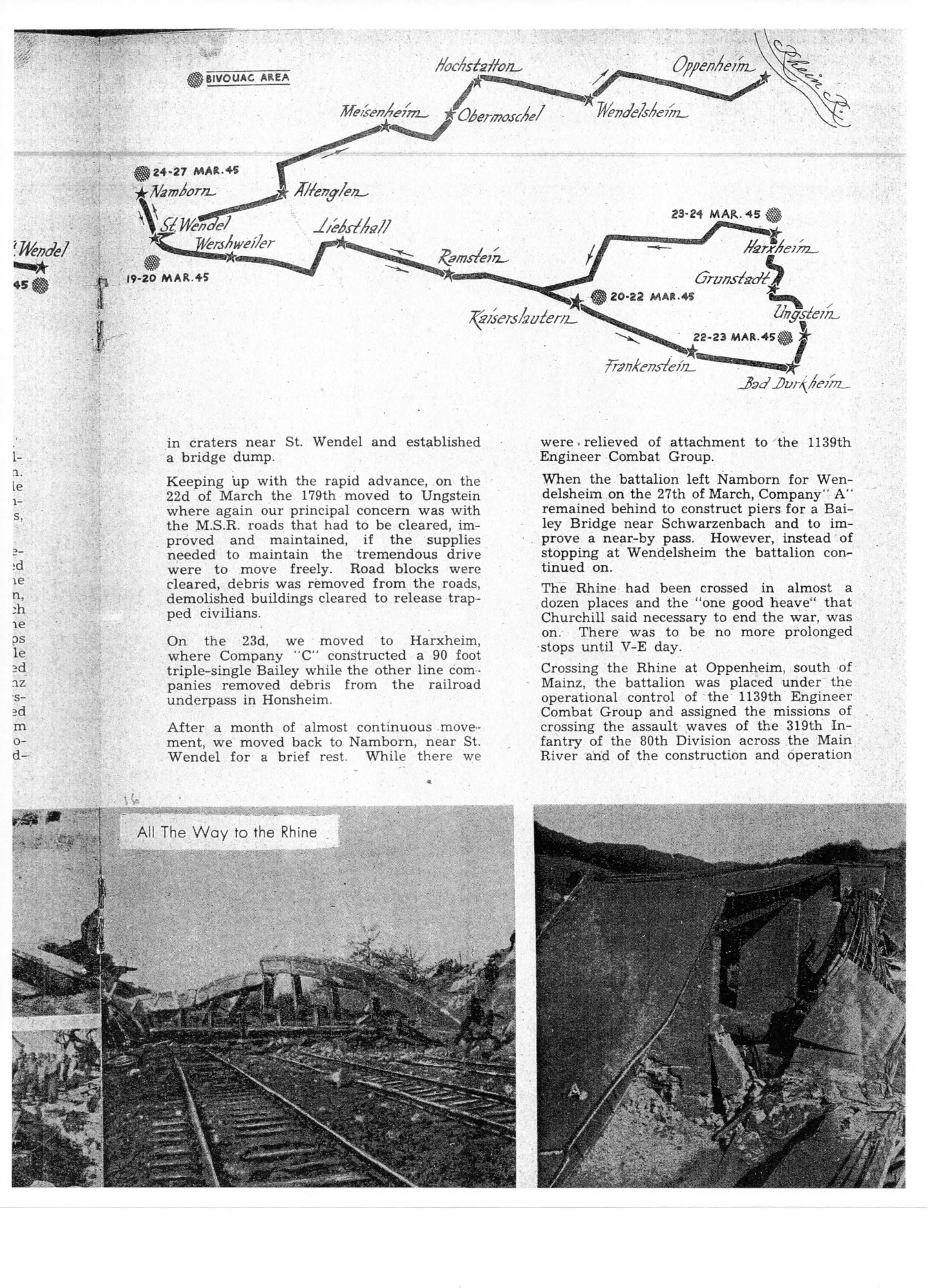
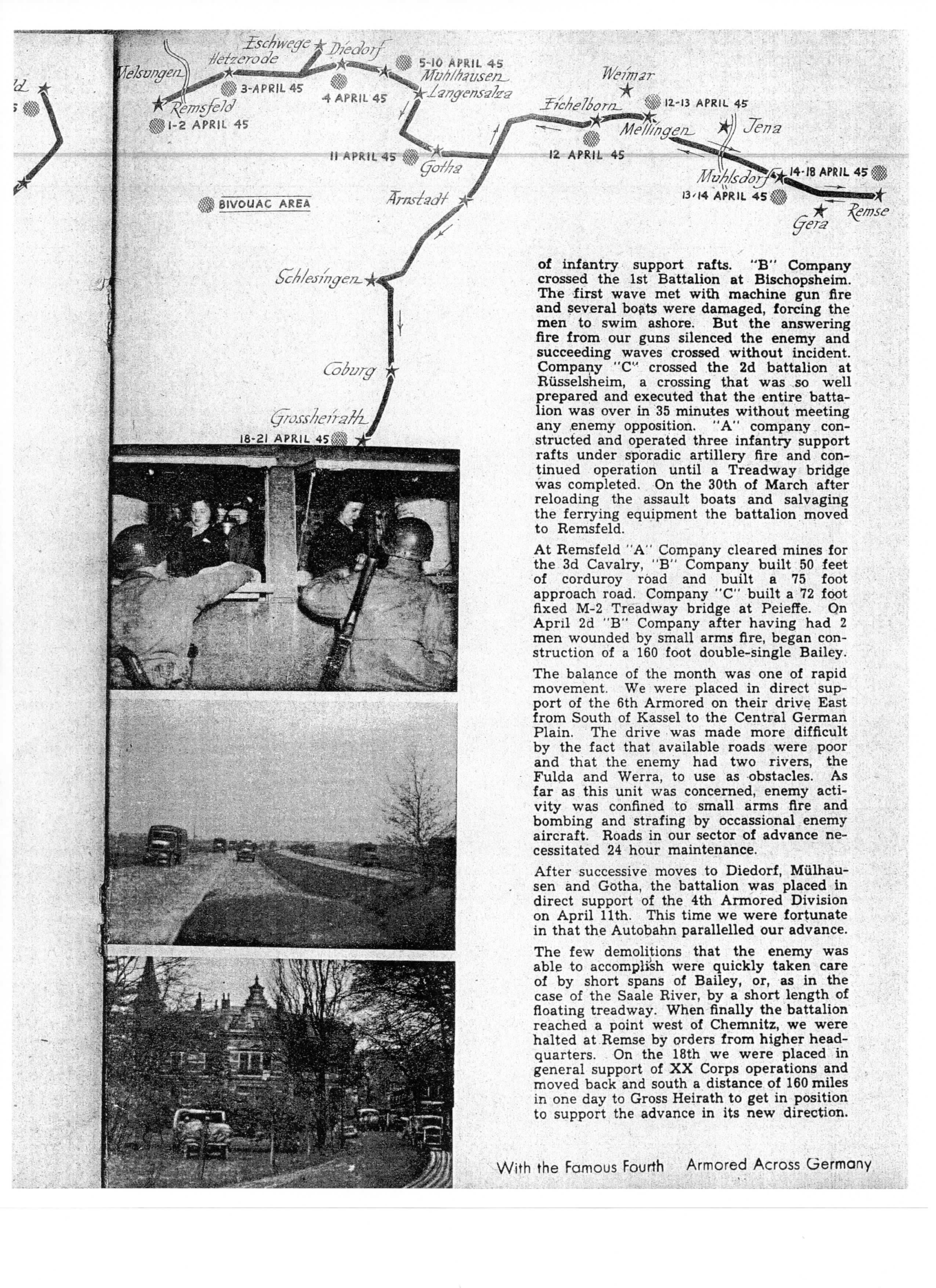
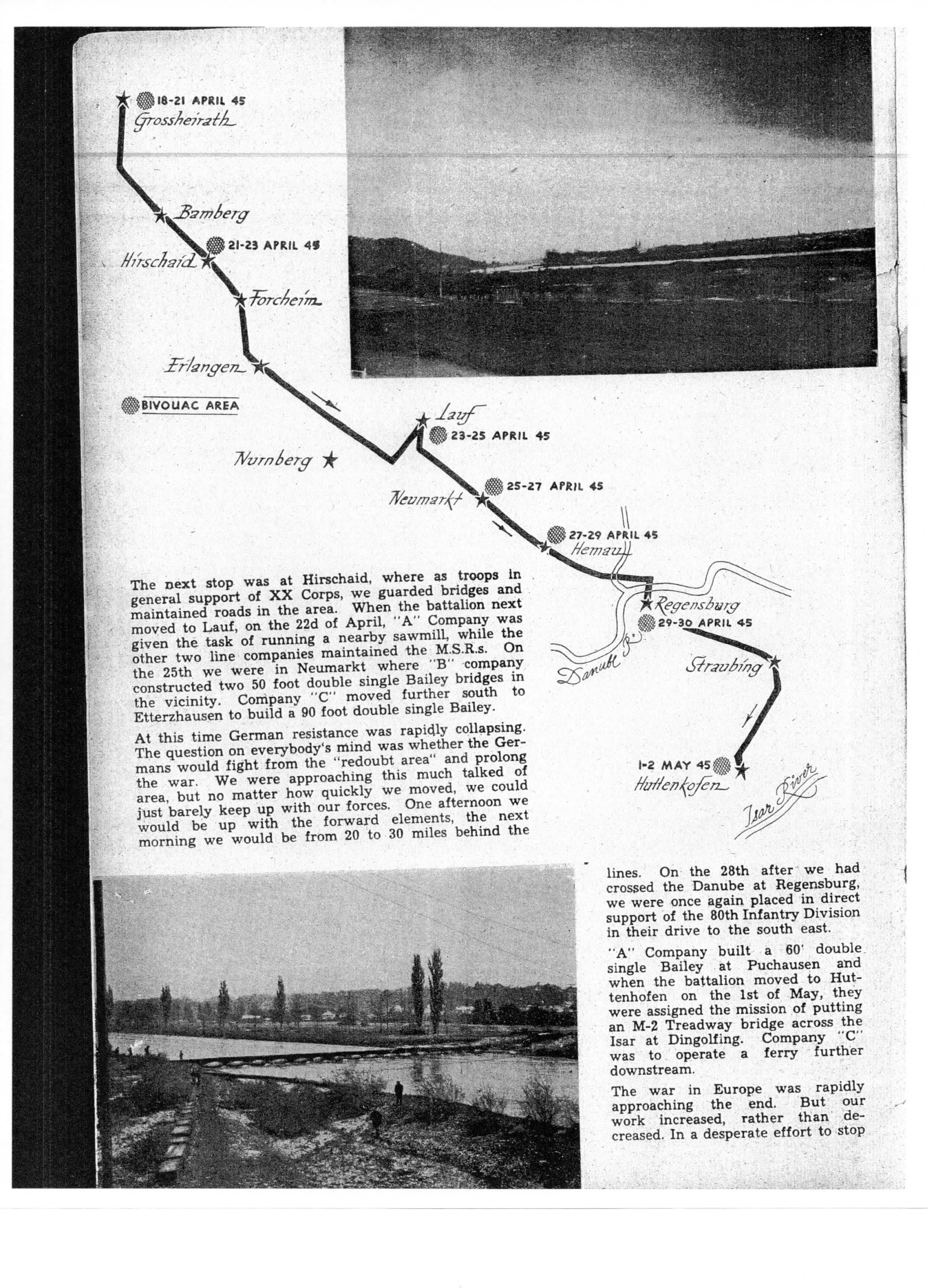
That spring the battalion crossed the Rhine at Oppenheim and made an assault crossing of the Main, where Company B ferried the 1st Battalion, 319th Infantry, across at Bischofsheim under machine-gun fire. On 28 April it reached the Danube at Regensburg.
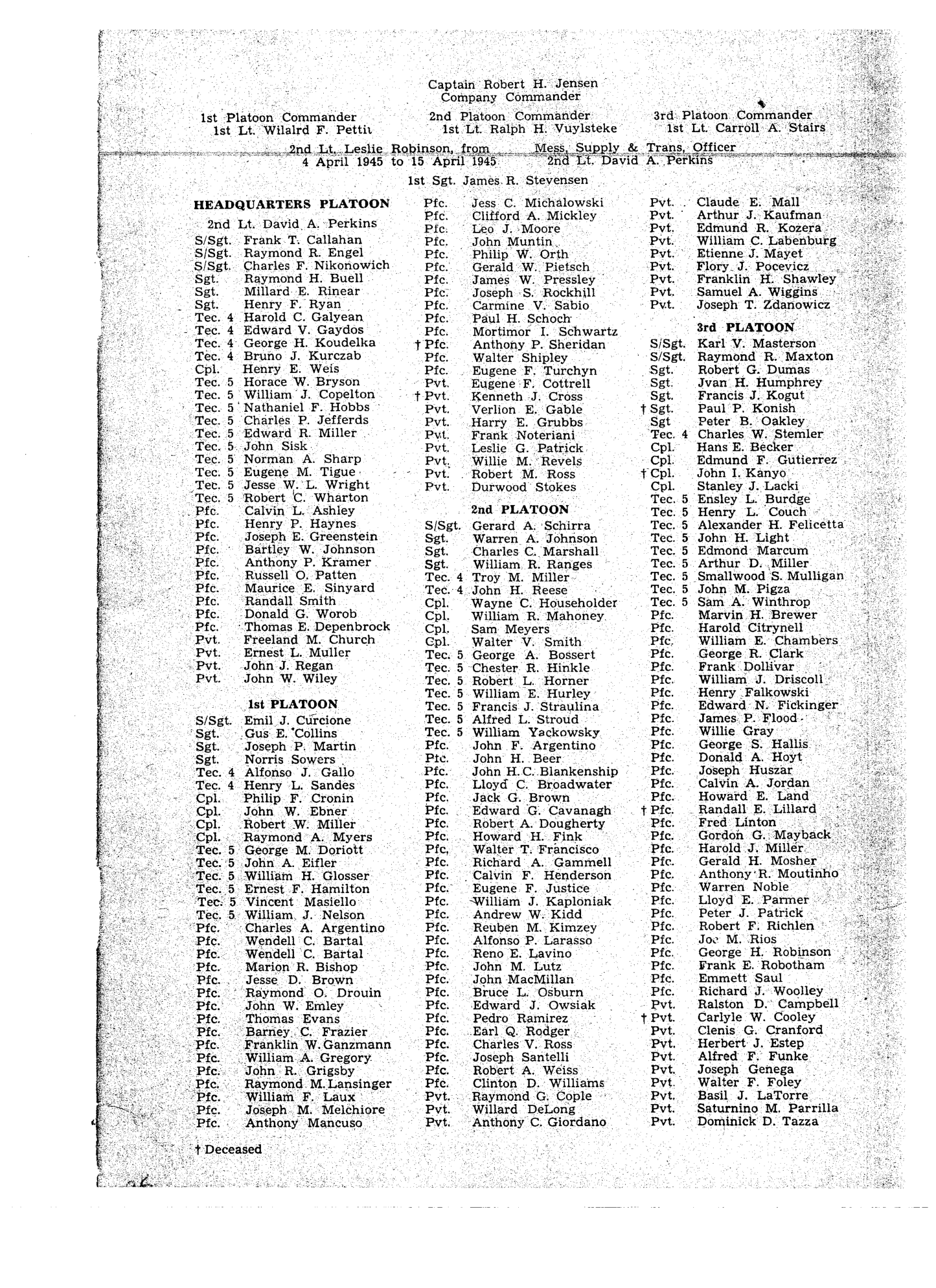
scanned record
Company B's roster from the battalion history. “2nd Platoon Commander, 1st Lt. Ralph H. Vuylsteke” is at the top, center. The yellow is ours — it marks his name and service number on the sheet.
scanned record
The battalion's Bronze Star roll. “1st Lt. Ralph H. Vuylsteke” is in the first column. The yellow is ours — it marks his name and service number on the sheet.
scanned record
Part 2, PDF page 2: the battalion crossed the Rhine and prepared for the Main crossing.
scanned record
Part 2, PDF page 4: Company B ferried infantry across the Main at Bischofsheim.
scanned record
Part 2, PDF page 5: the battalion reached the Danube at Regensburg.
Source: 179th Engineer Combat Battalion, battalion history, part 2, PDF pages 2–5, 12 (Company B roster), 16 (awards): https://ww2combatengineers.com/wp-content/uploads/docs/179th%20Engineers/179thPart2.pdf
Context
May 8, 1945

Victory in Europe, in Austria

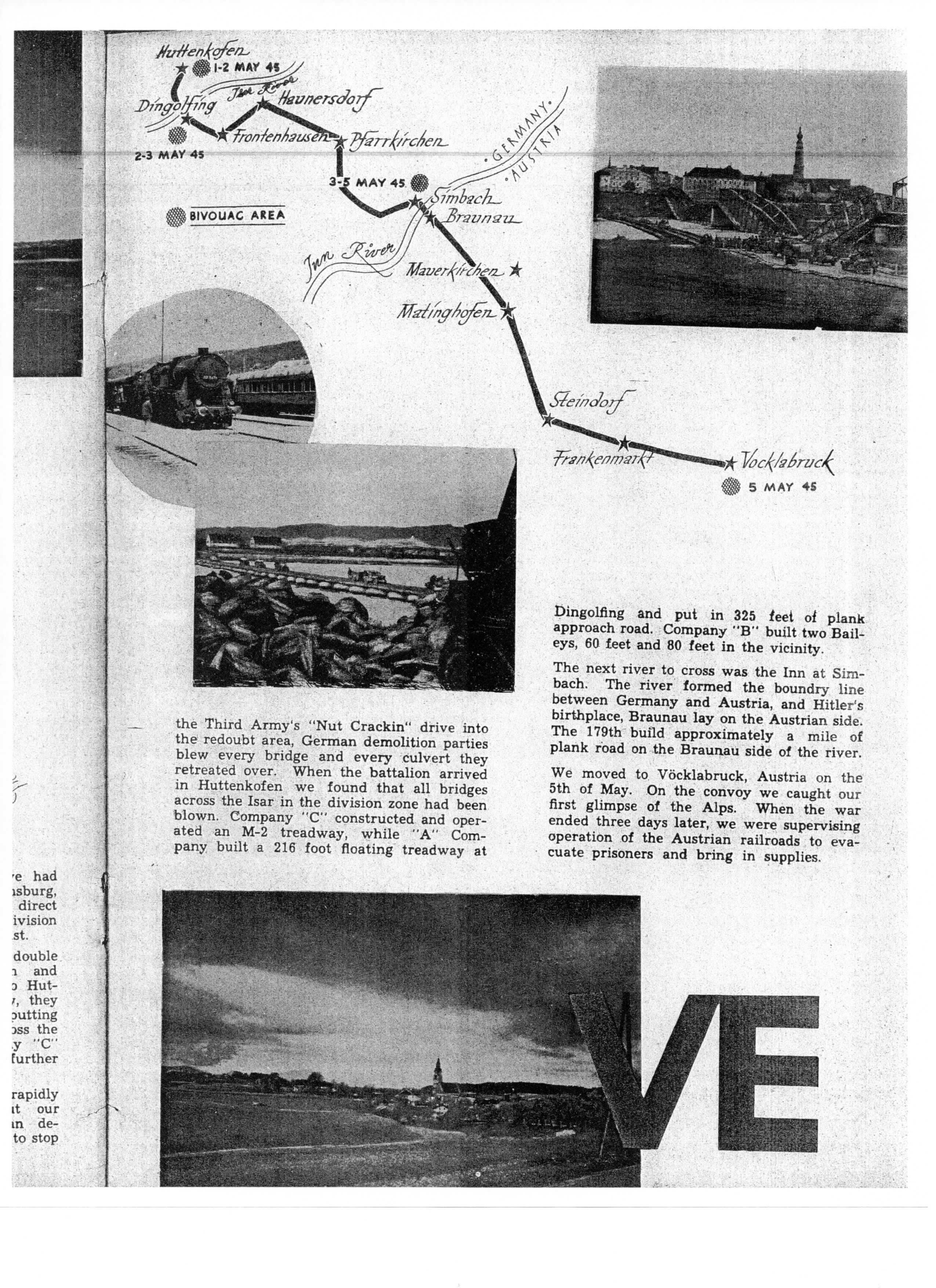
On 5 May the battalion reached Vöcklabruck, Austria. “On the convoy we caught our first glimpse of the Alps. When the war ended three days later, we were supervising operation of the Austrian railroads to evacuate prisoners and bring in supplies.” The war in Europe ended on 8 May 1945.
scanned record
The last leg of the battalion's war, from the Isar River to Vöcklabruck, Austria, 5 May 1945.
Source: 179th Engineer Combat Battalion, battalion history, part 2, PDF page 6: https://ww2combatengineers.com/wp-content/uploads/docs/179th%20Engineers/179thPart2.pdf
Confirmed — Service record
May 18, 1945

Bronze Star Medal

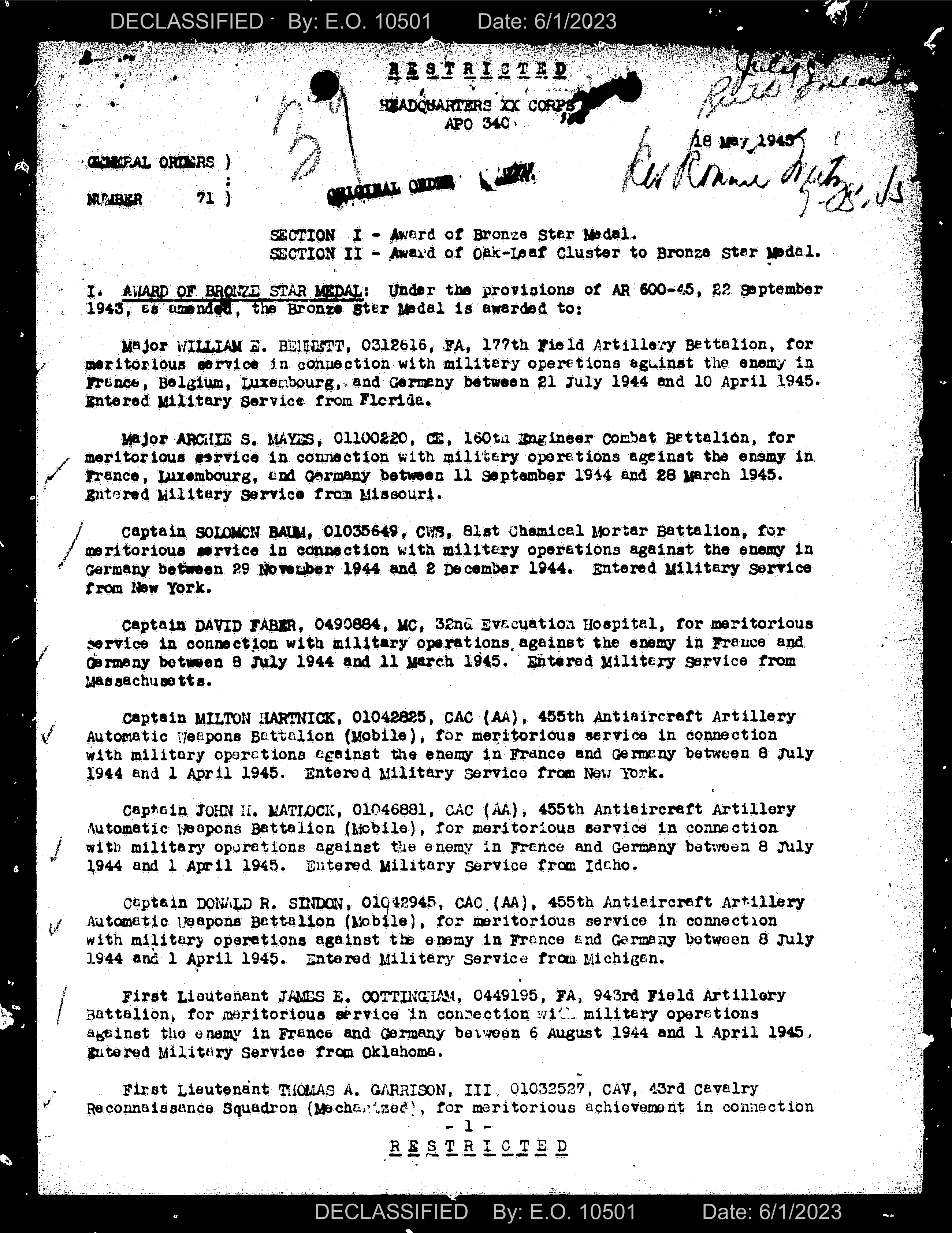
Ten days after the war in Europe ended, the headquarters of XX Corps published General Orders No. 71. Section I awards the Bronze Star Medal, and one of the entries reads:

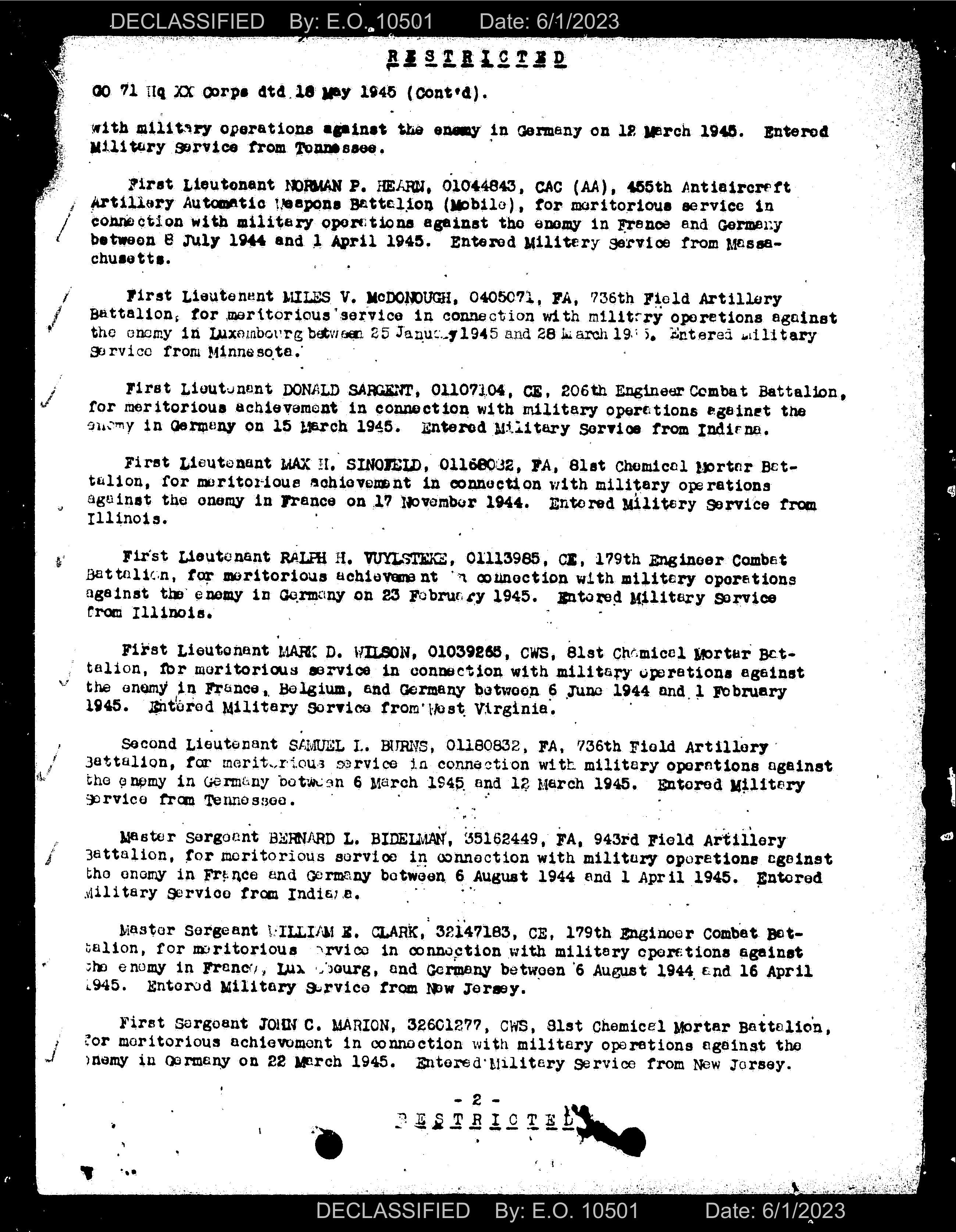
“First Lieutenant RALPH H. VUYLSTEKE, 01113985, CE, 179th Engineer Combat Battalion, for meritorious achievement in connection with military operations against the enemy in Germany on 23 February 1945. Entered Military Service from Illinois.”

The Bronze Star Medal was awarded for heroic or meritorious achievement in a combat zone. A corps was the headquarters above several divisions; XX Corps served in General Patton's Third Army. The citation also shows that by now he had been promoted to First Lieutenant, and that “CE”, the Corps of Engineers, was his branch.
scanned record
The order's first page: Headquarters XX Corps, 18 May 1945, “SECTION I – Award of Bronze Star Medal.”
scanned record
His citation on the second page of General Orders No. 71. The yellow is ours — it marks his name and service number on the sheet.
Source: General Orders No. 71, Headquarters XX Corps, APO 340, 18 May 1945, NAID 373989135
Confirmed — Service record
December 17, 1945

Released from the Army

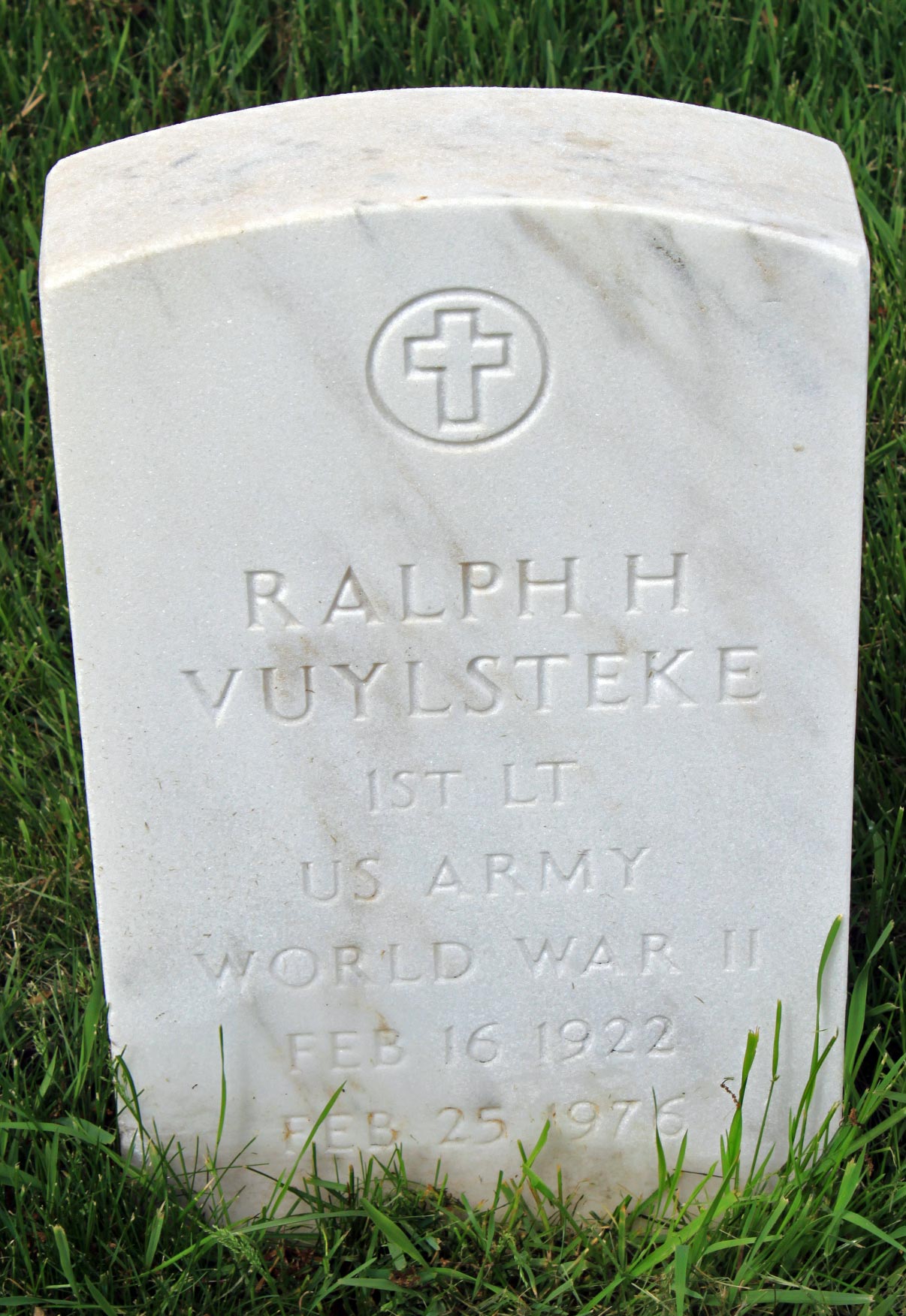
The Veterans Administration's service-date index lists 17 December 1945 as Ralph's release date, ending four years, nine months and twelve days of federal service.

He entered as a Private. Army orders and his government headstone identify him as a First Lieutenant; the orders also document his Bronze Star Medal.

View the service-date record transcription

VA Beneficiary Identification Records Locator Subsystem (BIRLS), retained database row 8991113: RALPH HARRY VUYLSTEKE; born 16 February 1922; died 25 February 1976; entered service 5 March 1941; released 17 December 1945. This is a transcription of the database fields.
scanned record
The Army order identifies First Lieutenant Ralph H. Vuylsteke and awards the Bronze Star Medal. The yellow is ours — it marks his name and service number on the sheet.
scanned record
His government headstone gives his rank as First Lieutenant.
Source: VA Beneficiary Identification Records Locator Subsystem, birls_full_2022.csv, retained database row 8991113, service-date fields transcribed above; General Orders No. 71, Headquarters XX Corps, 18 May 1945, page 2, NAID 373989135; government headstone, Find A Grave memorial #53133665
Confirmed — Record
June 18, 1950

An engineering degree from the University of Illinois
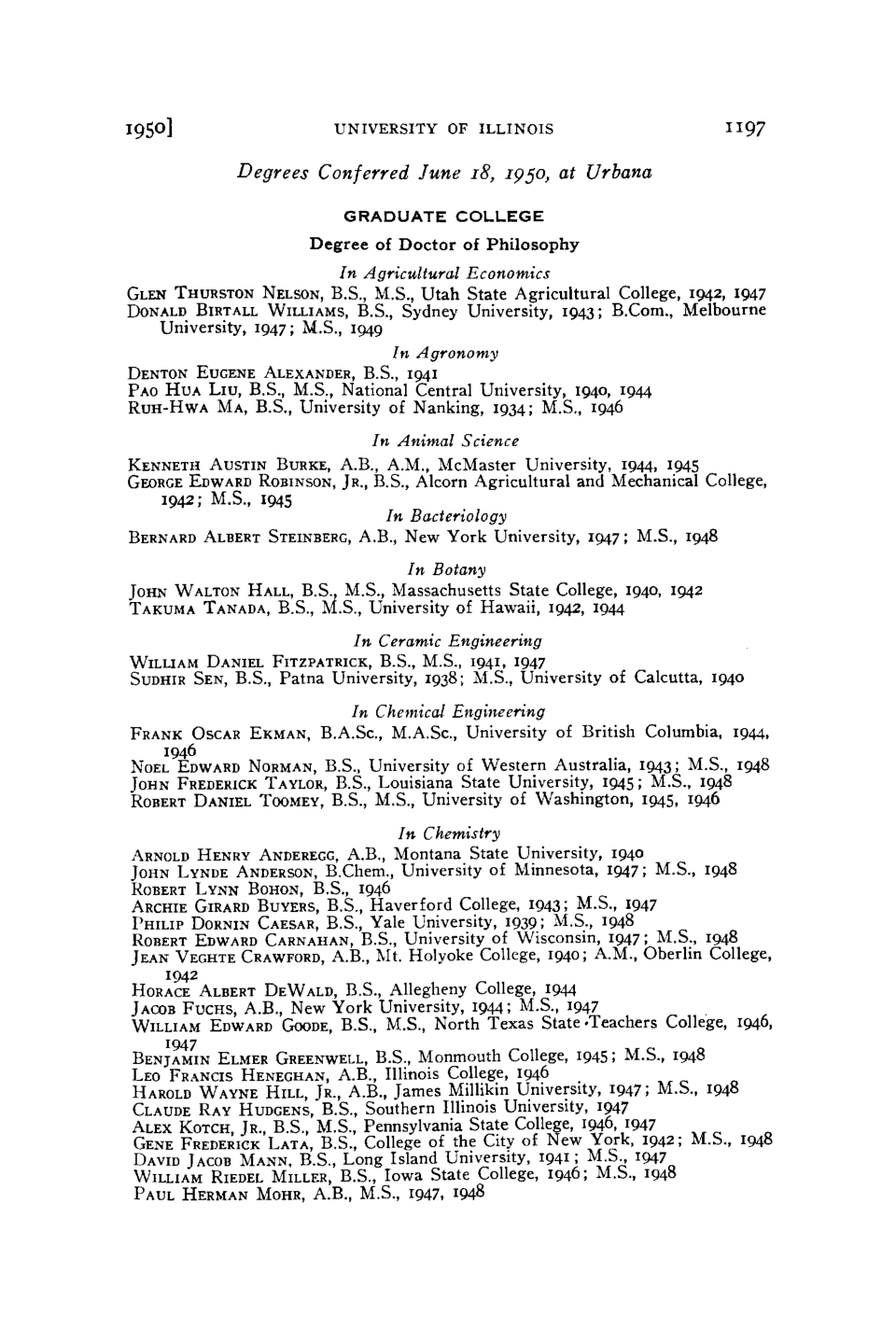
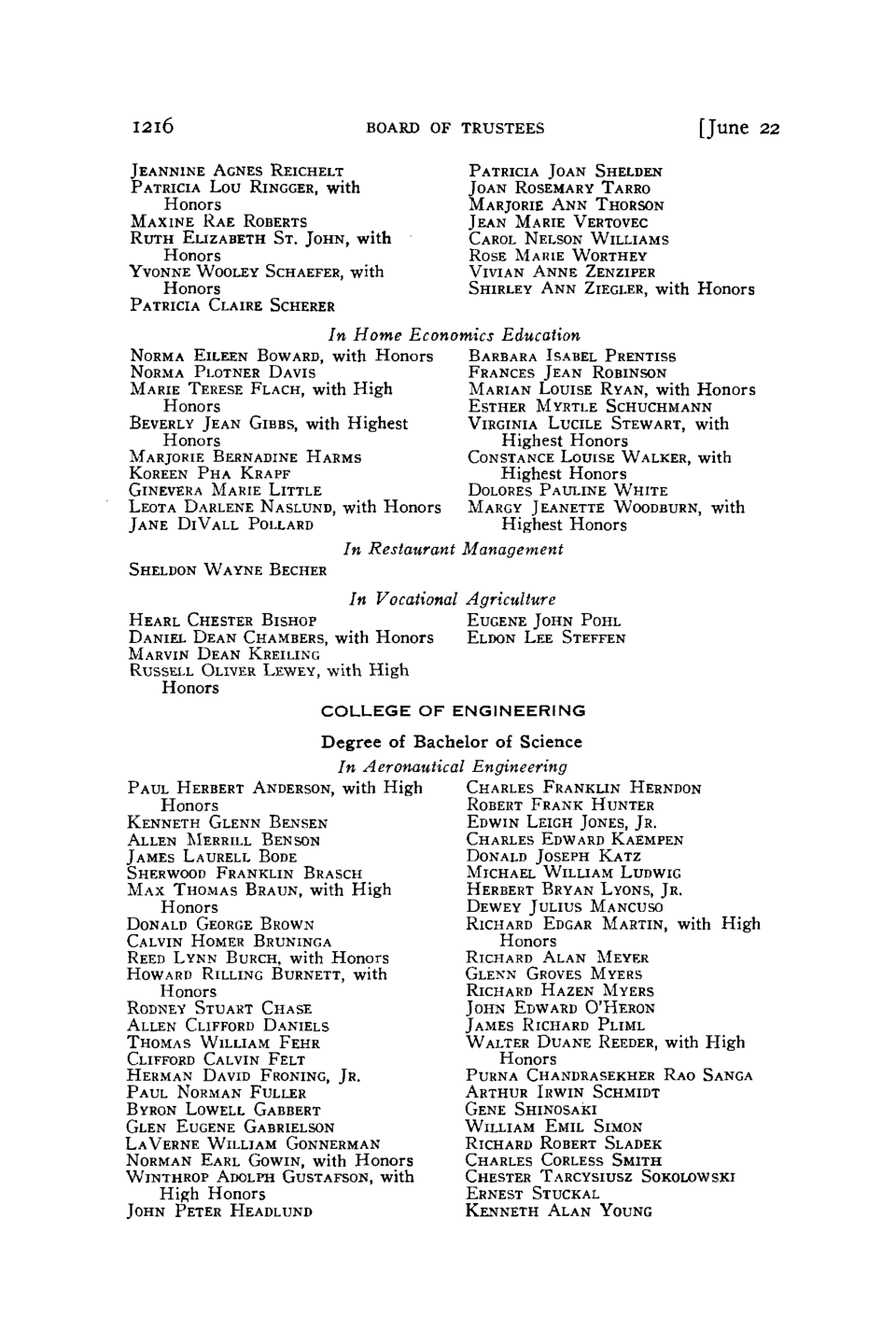
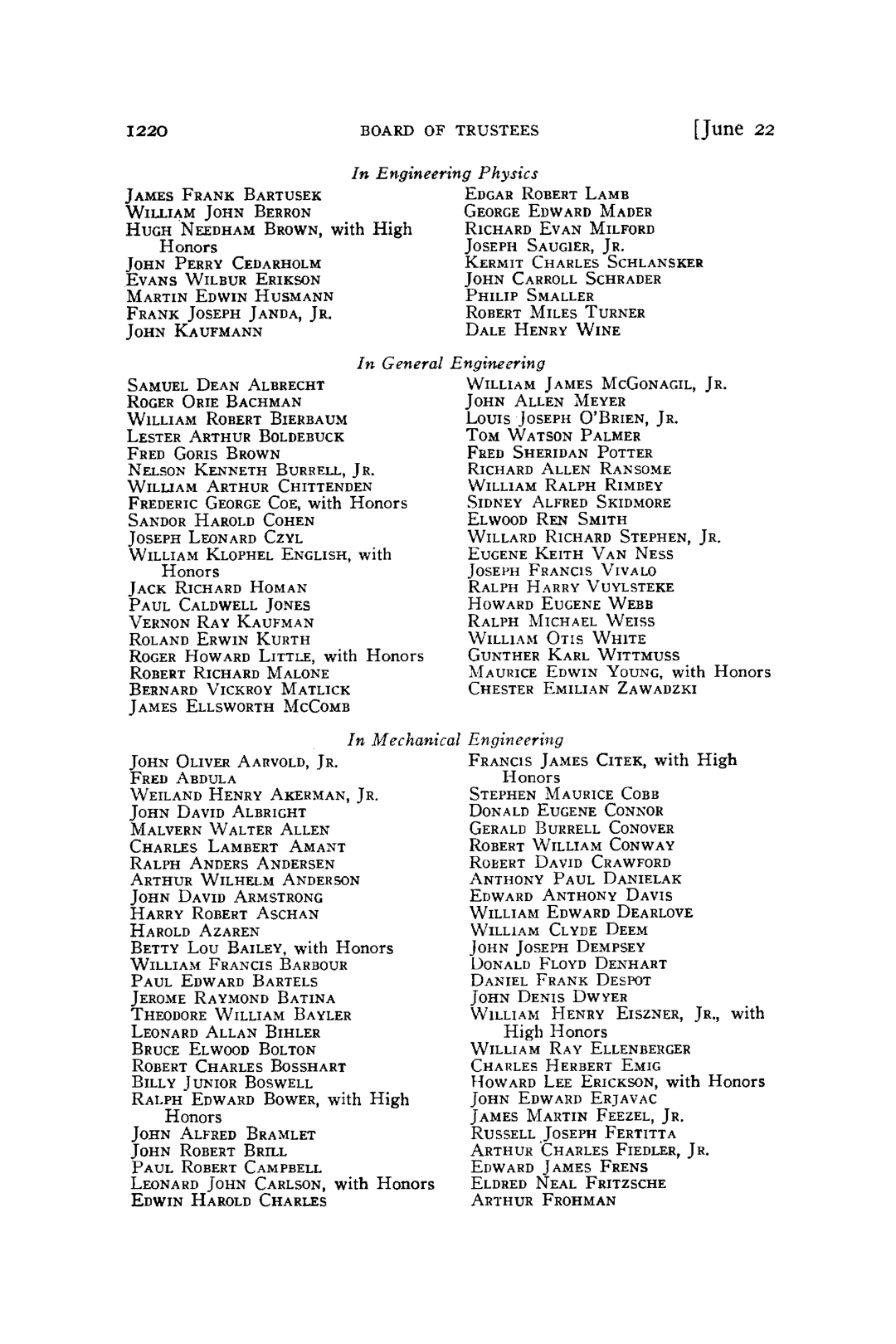
On 18 June 1950, Ralph earns a Bachelor of Science in General Engineering from the University of Illinois at Urbana. The university lists his full name among the graduates in its Board of Trustees minutes four days later.
scanned record
Printed page 1197: Degrees Conferred June 18, 1950, at Urbana.
scanned record
Printed page 1216: College of Engineering, Degree of Bachelor of Science.
scanned record
Printed page 1220: Ralph Harry Vuylsteke appears in the right column under In General Engineering. The yellow is ours — it marks his name and service number on the sheet.
Source: University of Illinois Board of Trustees, minutes of 22 June 1950, printed pages 1197 (conferral date), 1216 (Bachelor of Science heading) and 1220 (name under General Engineering), PDF pages 23, 42 and 46: https://www.trustees.uillinois.edu/trustees/minutes/1950/1950-06-22-uibot.pdf#page=46
Confirmed — Record
April 6, 1957

His mother dies at Heyworth

Helen K. Steiling Vuylsteke dies at home in Heyworth, aged 58. She was born at Vernon on 1 September 1898, a daughter of Henry and Clara Steiling, and had been a widow for thirty-one years. She is buried in Heyworth Cemetery, where Harry also lies.

Her obituary also shows where Ralph was living that spring: “a son, Ralph, Freeport”.
scanned record
“Mrs. Vuylsteke, Heyworth, Dies”: the obituary that names his father and both his sisters. The yellow is ours — it marks his name and service number on the sheet.
Source: Clinton Daily Journal and Public, 8 April 1957, page 6
Confirmed — Record
February 25, 1976

Ralph Harry Vuylsteke dies at Springfield, Illinois

He dies at Springfield, where he and Billie had lived since 1961, nine days after his fifty-fourth birthday. After the war the family had lived in North Chicago, Champaign, Quincy, Freeport and Jacksonville before settling in Springfield. Billie outlived him by thirty-five years.

View the family-history source excerpt

Billie Vuylsteke's 2011 obituary identifies her husband as Ralph Harry Vuylsteke of Heyworth, gives their marriage year as 1943, lists North Chicago, Champaign, Quincy, Freeport and Jacksonville before their move to Springfield in 1961, and says that Ralph died in 1976. It names their four sons as Richard, Les, John and Ken.

Source: Find A Grave memorial #53133665; VA Gravesite Locator; VA Beneficiary Identification Records Locator Subsystem; State Journal-Register (Springfield), 26 February 1976, obituary index entry (index only): https://www.familysearch.org/ark:/61903/1:1:Q5SS-GG73; obituary of Billie Vuylsteke, Boardman-Smith Funeral Chapel, Springfield, 2011: https://web.archive.org/web/20221207191132/https://www.boardmansmith.com/obituaries/Billie-Vuylsteke?obId=8549293
Confirmed — Record
Camp Butler National Cemetery

Buried at Camp Butler National Cemetery

Ralph rests in Section 3, Site 383-A, at Camp Butler National Cemetery outside Springfield. Billie's obituary announced burial with him on 2 December 2011. His government headstone gives his rank as First Lieutenant, U.S. Army, World War II.
scanned record
RALPH H VUYLSTEKE / 1ST LT / US ARMY / WORLD WAR II / FEB 16 1922 / FEB 25 1976. Photograph from his Find A Grave memorial.
Source: VA Gravesite Locator; Find A Grave memorial #53133665; obituary of Billie Vuylsteke, Boardman-Smith Funeral Chapel, Springfield, 2011